
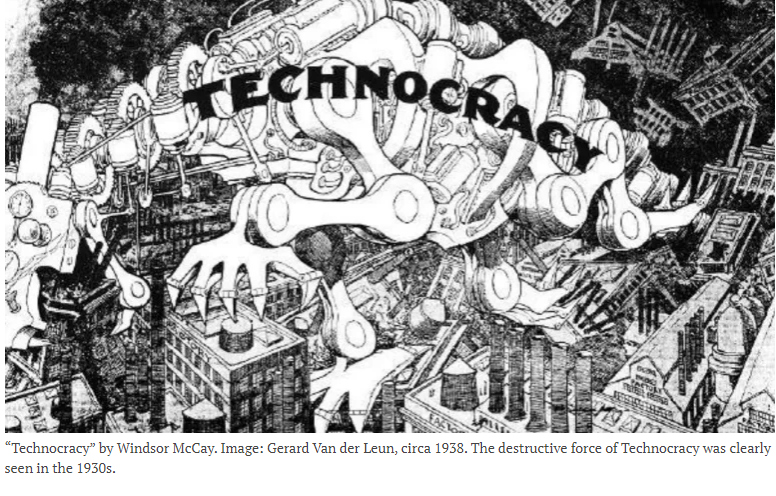
In my tattered copy of Henry A. Porter’s Roosevelt and Technocracy (1932), an early reader drew a careful bracket around a single passage on page 72. It reads: “Radical and immediate changes in both our political and economic systems will be necessary. This can best be accomplished by vesting supreme and emergency power in some one man who has the confidence and respect of a majority of the American people. That man is FRANKLIN D. ROOSEVELT — to whom should be given dictatorial powers in the approaching crisis.”1
It is one thing to know, as a generalization, that respectable Americans flirted with dictatorship in the winter of 1932–33. It is quite another to hold a commercially published book in which the proposition is worked out in numbered steps by a financial analyst, and to see that a contemporary reader found the decisive sentence and marked it. Whether that reader bracketed the passage in alarm or in agreement, the pencil does not say. The ambiguity is fitting, because the country itself had not decided.
Porter is nearly invisible to history, and that is precisely what makes him valuable. His title page bills him as a “Nationally known Economist and Financial Analyst” and lists his other works — Profitless Prosperity, Gentlemen of America, Romance of Natural Gas, Research or Retrogression, America’s Greatest Tragedy — titles that place him not in any university but on the investment-commentary circuit of the day.2
His publisher, the Wetzel Publishing Company of Los Angeles, was a small regional house. I have located no academic appointment, no archive of papers, no obituary of substance. In the ordinary run of intellectual history this would disqualify him from attention. For my purposes it does the opposite. The views of Howard Scott were the views of a movement’s impresario; the views of Columbia’s prestigious engineers were the views of an elite faction. Porter is evidence of something else: how far the technocratic idea had seeped into the commercial milieu — the men who wrote market letters, advised investors, and considered themselves hard-headed realists. When a proposal to abolish constitutional government appears in that literature, dressed in the sober vocabulary of financial analysis, the proposal has ceased to be fringe.
The book’s internal architecture makes the point sharper, because Porter did not begin as a radical. Chapter XII, “What Will Roosevelt Do?”, opens on page 55 with sentiments any Hoover-era financial conservative would have signed: “Many people believe that the government is primarily responsible for prosperity, and likewise for depression, when the fact is that the relations of government to prosperity or depression are negative rather than positive.”

