
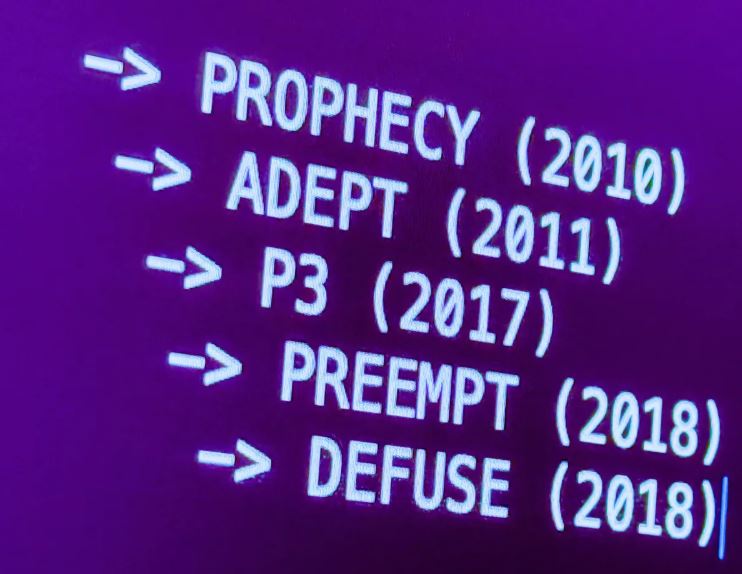
Beginning in 2010, the U.S. Defense Advanced Research Projects Agency (DARPA) launched a succession of biodefense programs that, viewed together, appear to form the architecture of a complete pandemic operating system: predicting genomic threats, converting sequence information into pharmaceuticals, compressing response timelines, extending surveillance into animal populations, and preparing interventions before any declared outbreak began.
The programs were called PROPHECY, ADEPT, P3, and PREEMPT.
A fifth project, DEFUSE, was submitted under PREEMPT and proposed applying that architecture specifically to bat coronaviruses.
Operation Warp Speed later supplied the industrial-scale manufacturing and deployment layer.
The conventional explanation is that these projects represented prudent pandemic preparedness.
But under my In Silico Theory of pandemic origins, another possibility emerges:
The U.S. military appears to have spent a decade constructing the computer sequence-based predictive, surveillance, diagnostic, pharmaceutical, and deployment infrastructure capable of orchestrating pandemics.
Under this framework, the central object is not necessarily a conventionally demonstrated physical virus.
It is the digital (in silico) sequence architecture accepted as a virus, and the vast machinery capable of converting that architecture into PCR targets, purported cases, surveillance data, computational variants, pharmaceutical products, and emergency policy.

