
By Drop Site News
BEIRUT, Lebanon—When the Israeli military repeated its displacement order for the entire city of Tyre (Sour) in southern Lebanon at 4 p.m. on Wednesday, Ali Sleiman decided to head to the shore with his fishing poles to pass the time. Neither he nor his relatives and neighbors believed that their small corner of the city would be targeted by the Israeli military. A stretch of low-rise residential buildings that butt up against the Palestinian refugee camp of El-Buss, the area is primarily made up of working class residents, both Lebanese and Palestinian, along with displaced families from surrounding areas.
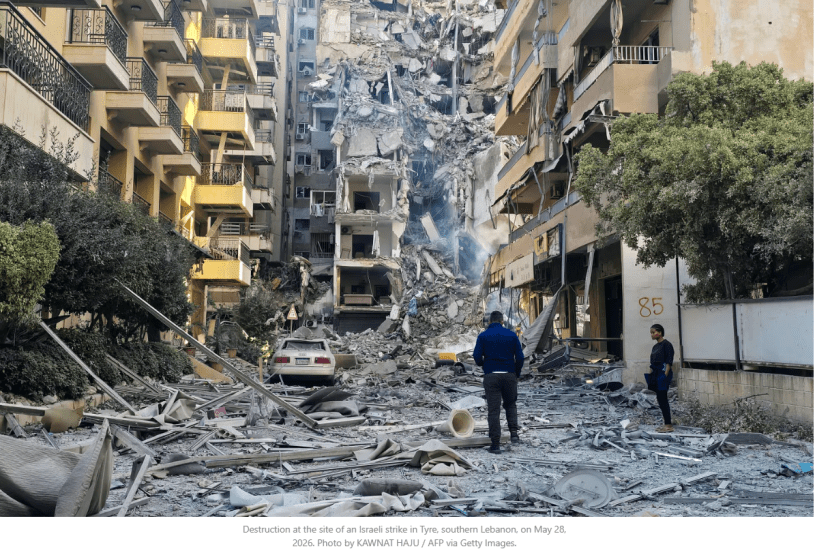
The airstrike came an hour later, shaking the earth and sending a thunderous boom throughout the city. Sleiman saw the cloud of smoke rise above his neighborhood and immediately left his supplies by the shore and sped home on his motorcycle. It was a direct hit on his family building. The strike had left a crater in the earth so deep that groundwater had begun to fill it. He screamed and dug through the rubble until he found his 82-year-old mother writhing in pain, her leg badly mangled. His brother’s lifeless body lay close by.
“I went crazy. I started shouting at the first responders, asking them where they were taking him,” Sleiman told Drop Site, his voice hoarse from breathing in the acrid smoke and fumes the day before. The airstrike killed three people, including his brother, Fadel, and injured at least 17 others. The entire residential block was destroyed.
“He was loving and respectful and incredibly giving,” Suleiman said of his brother, who left behind a wife and five children. Suleiman described Fadel as a familiar face in Tyre’s port, where he fished and painted boats for a living. “He was always helping the poor, always smiling.”
The Israeli strike was one of at least fifteen that rained down on Tyre overnight Wednesday and into Thursday morning, according to Moussa Shaalan, a member of the Lebanese Civil Defense stationed in Tyre. His voice was fatigued after a long night of retrieving survivors and the dead from the rubble. The Israeli military issued warnings for some residential buildings at 3:30 a.m. local time; other houses, like Sleiman’s, were bombed without warning.
“It was the worst night since the start of the war, and this has been the worst war we have seen,” Khalil al-Zein, a local official, told Drop Site.
 PERCEPTION RESET