
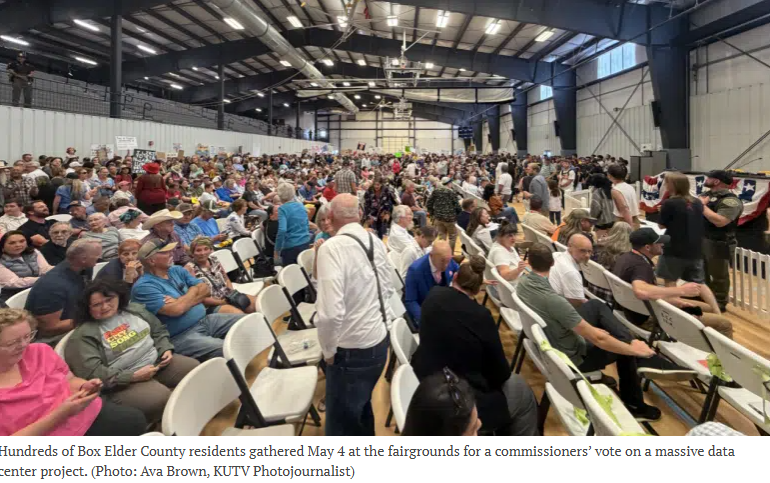
On the night of May 4, 2026, the Box Elder County Commission in northern Utah voted to approve one of the most audacious infrastructure proposals in American history. The project, dubbed Stratos, would consume 40,000 acres of land — an area roughly two and a half times the size of Manhattan — to house a sprawling network of artificial intelligence data centers powered by a 9-gigawatt on-site energy complex. The face attached to this venture is Kevin O’Leary, the flamboyant Shark Tank investor known as “Mr. Wonderful.” But behind the celebrity branding lies a blueprint that should concern anyone paying attention to how infrastructure decisions in this country are increasingly being made without the consent of the people who live there.
The vote did not come quietly. Hundreds of residents packed commission meetings and courthouse hallways. They carried signs. They demanded answers. And when the vote came down, many of them left feeling that the process had been designed from the beginning to sidestep them entirely. They were right to feel that way.
One of the most revealing features of the Stratos approval was its velocity. Residents reportedly received just three days’ notice before the first commission hearing. Commissioners themselves acknowledged they had been handed the proposal at the last hour and told to move quickly. No completed environmental assessment. No traffic study. No biological survey. The customary mechanisms of public oversight — the ones that exist specifically to slow down decisions of this magnitude — were simply not in place.
This is not an oversight. This is a method.
When powerful infrastructure projects need to bypass the friction of democratic deliberation, speed becomes the primary tool. The faster a proposal moves, the less time an organized opposition has to form. The less time researchers have to scrutinize the fine print. The less time elected officials have to ask the inconvenient questions that might derail a deal worth billions of dollars. What happened in Box Elder County was a textbook illustration of how large-scale technocratic development works in practice: the decision was effectively made before the public meeting began, and the public meeting existed largely for the record.

