
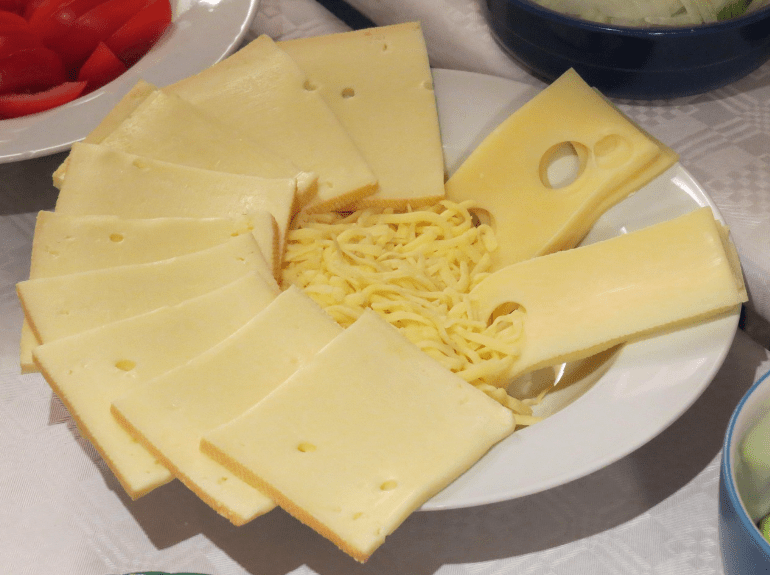
Many Americans were surprised to learn that roughly 90 percent of cheese contains a lab-made enzyme developed by Pfizer, and it does not have to be labeled.
The ingredient, known as fermentation-produced chymosin (FPC), is a genetically engineered version of rennet, an enzyme used to coagulate milk during cheesemaking.
While FPC has been used for decades, a viral social media post this week brought renewed attention to its origins, sparking widespread backlash and calls for greater transparency.
On X, one user asked, ‘How is this allowed?’ and others vowed to stop buying American-made cheese, saying: ‘[A] boycott is the only way.’
Another user shared: ‘Unfortunately, I won’t be buying American cheese anymore without reading the labels very carefully.’
FPC was developed in 1990, when Pfizer scientists engineered a microorganism to produce chymosin, the key enzyme found in calf rennet.
The innovation revolutionized cheesemaking by making the process cheaper, faster and more consistent.
The US Food and Drug Administration (FDA) approved FPC as ‘Generally Recognized as Safe’ (GRAS), a regulatory designation that allows substances to enter the food supply without full pre-market approval.
The FDA’s decision relied in part on a 90-day rat feeding study.
 PERCEPTION RESET