
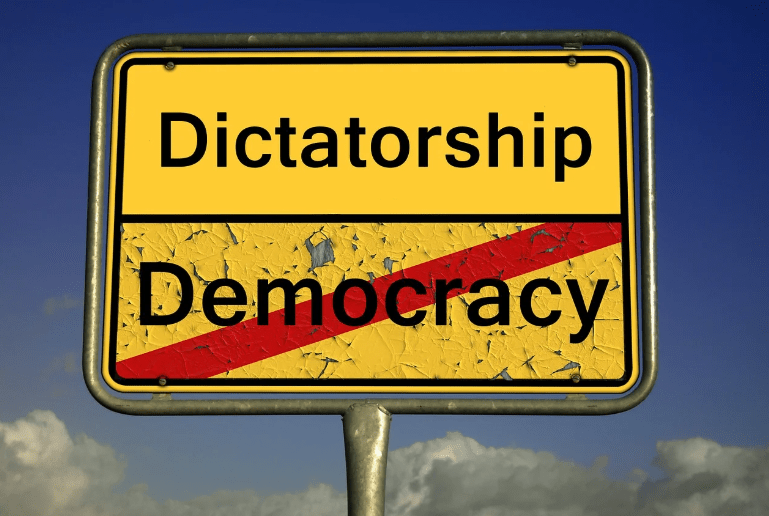
Trilateral Commission member John Podesta worked for another Trilateral, Bill Clinton, when he came up with the idea of ruling “with a pen and a phone.” It was refined under the Obama presidency and is now set in stone by Trump, who has executed 221 executive orders in 323 days. This EO overrules States’ Rights and sets up contentious legal battles as states try to maintain sovereignty. President Trump is greasing the skids to usher in the Age of Technocracy. ⁃ Patrick Wood Editor.
ENSURING A NATIONAL POLICY FRAMEWORK
FOR ARTIFICIAL INTELLIGENCE
December 11, 2025
By the authority vested in me as President by the Constitution and the laws of the United States of America, it is hereby ordered:
Section 1. Purpose. United States leadership in Artificial Intelligence (AI) will promote United States national and economic security and dominance across many domains. Pursuant to Executive Order 14179 of January 23, 2025 (Removing Barriers to American Leadership in Artificial Intelligence), I revoked my predecessor’s attempt to paralyze this industry and directed my Administration to remove barriers to United States AI leadership. My Administration has already done tremendous work to advance that objective, including by updating existing Federal regulatory frameworks to remove barriers to and encourage adoption of AI applications across sectors. These efforts have already delivered tremendous benefits to the American people and led to trillions of dollars of investments across the country. But we remain in the earliest days of this technological revolution and are in a race with adversaries for supremacy within it.
To win, United States AI companies must be free to innovate without cumbersome regulation. But excessive State regulation thwarts this imperative. First, State-by-State regulation by definition creates a patchwork of 50 different regulatory regimes that makes compliance more challenging, particularly for start-ups. Second, State laws are increasingly responsible for requiring entities to embed ideological bias within models. For example, a new Colorado law banning “algorithmic discrimination” may even force AI models to produce false results in order to avoid a “differential treatment or impact” on protected groups. Third, State laws sometimes impermissibly regulate beyond State borders, impinging on interstate commerce.
My Administration must act with the Congress to ensure that there is a minimally burdensome national standard — not 50 discordant State ones. The resulting framework must forbid State laws that conflict with the policy set forth in this order. That framework should also ensure that children are protected, censorship is prevented, copyrights are respected, and communities are safeguarded. A carefully crafted national framework can ensure that the United States wins the AI race, as we must.
Until such a national standard exists, however, it is imperative that my Administration takes action to check the most onerous and excessive laws emerging from the States that threaten to stymie innovation.
Sec. 2. Policy. It is the policy of the United States to sustain and enhance the United States’ global AI dominance through a minimally burdensome national policy framework for AI.
Sec. 3. AI Litigation Task Force. Within 30 days of the date of this order, the Attorney General shall establish an AI Litigation Task Force (Task Force) whose sole responsibility shall be to challenge State AI laws inconsistent with the policy set forth in section 2 of this order, including on grounds that such laws unconstitutionally regulate interstate commerce, are preempted by existing Federal regulations, or are otherwise unlawful in the Attorney General’s judgment, including, if appropriate, those laws identified pursuant to section 4 of this order. The Task Force shall consult from time to time with the Special Advisor for AI and Crypto, the Assistant to the President for Science and Technology, the Assistant to the President for Economic Policy, and the Assistant to the President and Counsel to the President regarding the emergence of specific State AI laws that warrant challenge.
 PERCEPTION RESET