

The hunger for data knows no bounds. Your location history, browsing data, and communications aren’t enough to satisfy the surveillance economy. Tech companies now seek data from your mind and body.
The parable of the Greek king Erysichthon comes to mind. Erysichthon was a greedy and powerful ruler focused on expanding his empire. In the search for lumber to build a grand feasting hall, he ventured into a grove of sacred trees belonging to the Goddess Demeter.
Ignoring the hesitation of his people who revered the sacred site, and defying warnings from the Gods, Erysichthon chopped down the sacred grove.
Demeter, outraged by his disrespect to the divine connection between nature and man, cursed him with the spirit of insatiable hunger. The more he ate – the stronger his hunger became.
Erysichthon tried to satisfy his appetite. He obsessively bought food from all over the world and spent all his time eating. Eventually he depleted his fortune, sold off his possessions, sold his daughter for crumbs, and ended his life with one final meal – his own withering body.
Just as Erysichthon was consumed by hunger, today’s tech companies are driven by an insatiable desire for data. And our bodies are the next frontier.
Fortunes are being spent on building the devices and infrastructure that will track our biological signals. In the next few years bio-sensors will be small enough to be easily worn and gather a wide range of data.
This article is your official invitation to join the “Internet of Bodies” or to reject it completely. We’ll cover the history of IoB, the latest development in bio-sensors, how tech companies are driving the IoB agenda forward, and how it will make its way into your life.
The Internet of Bodies
The term “Internet of Bodies” (IoB) was coined by the RAND Corporation, a highly-influential U.S think tank founded in 1948.
After World War II, RAND redirected military minds towards defense research, shaping policies around nuclear weapons, defense strategy, satellites technology, and beyond. Today RAND research branches out to health, education, and societal research.
RAND Corporation always seemed to be ahead of the curve, releasing research reports that anticipated and informed the development of world-changing technology like satellites, distributed networks (the Internet), and artificial intelligence.
In the 2020 report, titled “The Internet Of Bodies”, RAND researchers predicted the future will be full of internet-connected medical devices tracking our health data in real time.
Is this prediction coming from out of nowhere, or is RAND telegraphing an upcoming shift within the technology industry?
“It is challenging to identify an important national policy issue during the past 50 years that RAND did not play a role in resolving,” – David Jardini 2013
RAND researchers classified IoB devices as devices that:
- Contained software or computing capabilities
- Communicated with the internet
- Collected person-generated health or biometric data OR
- could alter the human body’s function
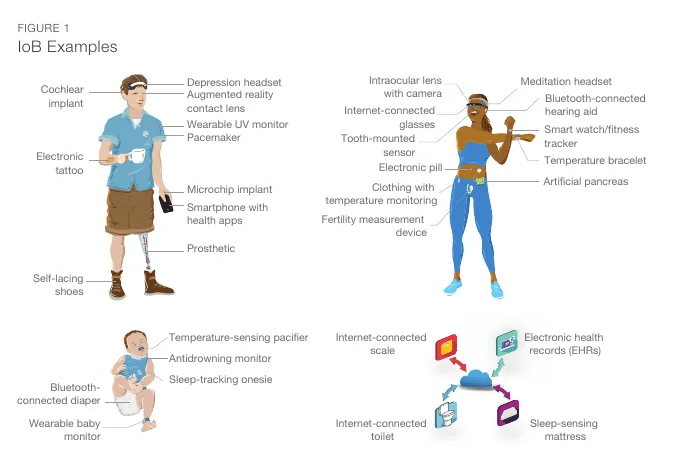
Every IoB device conducts biosurveillance: continuously collecting health data, broadcasting it remotely to analyze behaviors, and intervening as needed.
The illustrated examples in the IoB report are harebrained as they appear, like the bluetooth-connected diaper. The Internet of Bodies expects you to pay more attention to the diaper notifications on your phone rather than hearing your child’s cries, or smelling the odor of their distress.
Some notable examples include:
- Implantable microchips that contain your personal or identification information.
- Wearable health trackers that track your heart rate, sleep patterns, and physical data
- Mental and emotional sensors designed to detect how you’re feeling by analyzing your expression and voice.
- Wearable neuro-devices that monitor your brain and stimulate the brain through electrical signals.
- Attention monitoring that tracks your brain activity and eye movements.
 PERCEPTION RESET