
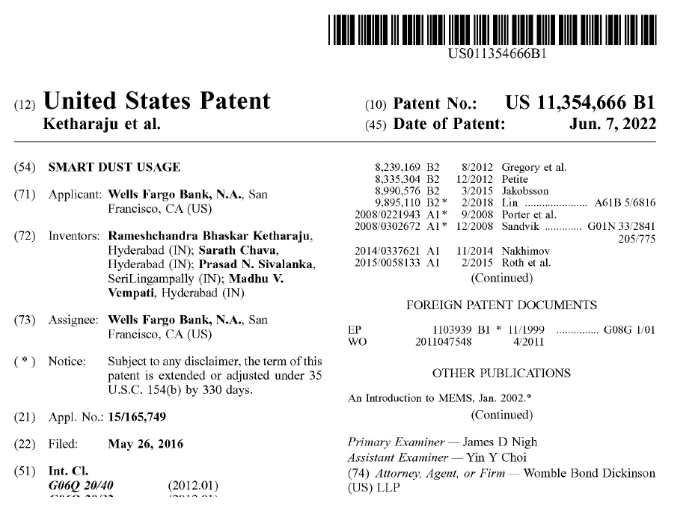
Dr Staninger sent me some information on smart dust, so I wanted to write an update on how this technology is the basis for the 4th Industrial Revolution and the Internet of bodies bio surveillance grid. It can be inhaled and give environmental data to a computing network. Its being used in healthcare for drug delivery, for biometric authentication by banks, for military surveillance of combat zones (and civilians), for Internet of bodies, its in food, it is sprayed for meteological purposes and we just happen to inhale it – it is the invisible microsensor grid network everywhere.
Here is a 2010 article from CNN
‘Smart dust’ aims to monitor everything
These “smart dust” particles, as he called them, would monitor everything, acting like electronic nerve endings for the planet. Fitted with computing power, sensing equipment, wireless radios and long battery life, the smart dust would make observations and relay mountains of real-time data about people, cities and the natural environment.
The government technology website published this article in 2010 that gives a great overview of what smart dust is and how it works:
Health and Human Services Dust in the Wind
In 1997, while a professor at the University of California at Berkeley, Kris Pister proposed a project to deliver sensing, computing and networking in a millimeter-sized package. The project, called Smart Dust, was funded by DARPA the same year.
The idea was to make low-cost, battery-operated wireless sensor networks to drop over a battlefield or other areas of interest, or place them quickly and easily in a variety of buildings and structures to evaluate the situation, said Pister, who is president and CEO of Dust Inc. “You can monitor when people or vehicles go by, you can track things, whether they’re enemy combatants or civilians — there are all sorts of great things you can do if you’ve got the sensors to do it,” he said. “It’s all stuff you can do today if you spent the time and money to wire it all up, but you don’t have that luxury in a battle or in a foreign country you’re about to have a battle in — you just can’t get in there with a wired system.”
Beginnings
A Smart Dust “mote” is a sensor-processing node — a millimeter-sized point in a network that observes and records its surroundings. Information these motes collect varies depending on what you want to observe, said Steven Glaser, associate professor for the Department of Civil and Environmental Engineering at UC Berkeley. “It has a microcontrollor, two-way radio, buffer memory and so on and so forth, and it’s dynamically reprogrammable, so you can change what it can do at a later time,” he said. “It’s a smart device; they have an operating system that allows devices to talk to each other, and [transfer] data without the interference from an outside boss, so it’s a peer-to-peer network.”
Smart Dust uses ad hoc networks, Glaser said, which means the devices set the network up themselves on the fly, and the network structure changes through time.
The network can also be set up arbitrarily, Glaser added, and because the motes or nodes are autonomous, they self-assemble into a network. Intermediate nodes help distant nodes reach the mother unit, which controls the sensor data, and is connected to a PC, known as the base station. The sensors use an open source software program for wireless networks called TinyOS to talk to each other. David Culler, a professor of computer science at UC Berkeley who directs the Intel Research laboratory at the university, wrote TinyOS.
When a new technology is announced, people tend to doubt its reliability until it is proven, which is what Culler, Glaser, Pister and everyone else with their hands in the Dust, are working on. Initially testing in the environment made the most sense because the nodes could be dispersed and collect data without affecting anyone.
“How do you go through the steps and develop a trust with new technology?” Culler said. “The natural place to start was the environment. For one thing, it doesn’t move.” Glaser and his graduate students, in conjunction with the Lawrence Berkeley National Laboratory, are measuring humidity in the nuclear waste repository being planned in Yucca Mountain, Nev. The device traditionally used to measure humidity in the repository is large and emits a lot of heat, Glaser said, which changes the humidity.
Because Smart Dust is so small, it can operate for long periods without wires and send data from locations where a large device wouldn’t go. It was the perfect candidate. Glaser also has upcoming projects in Israel and China.
So far, the largest number of motes dispersed in an area is several hundred, Culler said, adding that development to make the networking easier is ongoing, and assembling the networks is still a fair amount of work.
Smart Dust motes are considered cheap — a few hundred dollars each, Glaser said, but prices will lower because right now they’re still considered research devices. As they become commercial, the cost will lower considerably because much of the cost is development. “The sensors can range — let’s say for vibration — from $5 apiece to $1,000 apiece, depending on how sensitive you want them for what you need,” Glaser said. “If you’re looking at very strong earthquake response, and you’re not interested in small tremors but real earthquakes, then the $5 piece works just fine.”
The top 5 MEMS manufacturers have been changing healthcare as we know it and the MEMS sensors have been implemented everywhere:
 PERCEPTION RESET