
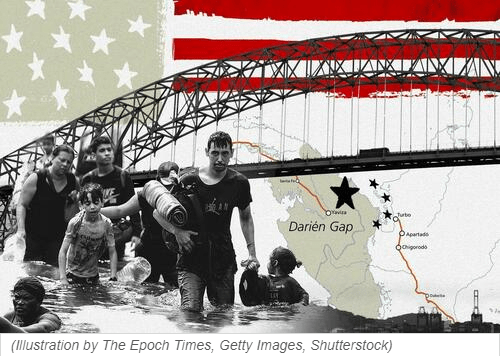
The grind of heavy machinery breaks the silence of the Darién jungle, where the Pan American Highway ends at Yaviza in Panama.
Construction workers have cleared towering trees to make way for a steel and concrete bridge mighty enough to withstand flooding from the Chucunaque River.
An onsite worker for the construction company Cusa told The Epoch Times the construction project will cut 4 miles into the Darién jungle at a cost of $42 million and includes a second bridge crossing the Tuira River.
That would leave some 55 miles to finish the Pan American Highway, also known as Highway 1, through the mountainous rainforest to connect it to Turbo, Colombia.
If it’s ever completed, the Pan American Highway will stretch about 18,000 miles from Alaska to Argentina, opening up a land corridor the length of the Americas.
It has gone unfinished for decades due to American and Panamanian concerns over the environment, crime, and disease—and more recently mass migration. The dangerous, rugged terrain acts as a natural barrier to travel from South to Central America.
The bridge and road expansion will end near the town of Bocas de Cupe, in the Darién Gap. However, bridging the rivers has been considered one of the major obstacles blocking completion of the highway.
The new project has worried some who fear completing the road into the Darién Gap will be a win for China and a loss for America.
Michael Yon, a former war correspondent, has been covering mass migration through Panama for several years and has used social media to bring attention to the bridge’s construction and its implications.
China would benefit through an alternate trade route around the Panama Canal, which is essential to global trade. But for the United States, it could open the floodgates to migrants from South America, he told the Epoch Times.
Meanwhile, U.S. leaders have grown increasingly wary of the military implications tied to Chinese infrastructure projects being built in America’s backyard as part of its Belt and Road Initiative (BRI), particularly around the Panama Canal.
In 2018, Panama signed on to China’s ambitious BRI project, dubbed a modern Silk Road, after publicly recognizing Taiwan as part of China, much to the surprise and concern of the United States.
The CCP aims to utilize the BRI “to amass power and influence at the expense of the world’s democracies,” U.S. Southern Command Commander Army Gen. Laura Richardson warned in March.
She and other commanders in recent years have been sounding the alarm about China’s incursion into the Western Hemisphere.
China “seeks to supplant the United States as the world’s leading economic and military power,” Gen. Richardson noted in a written statement to the House Armed Services Committee.
 PERCEPTION RESET