
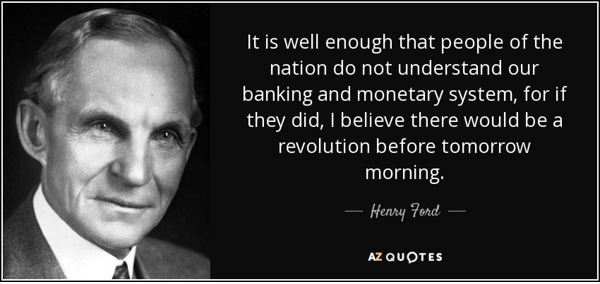
Henry Ford astutely observed that a revolution would occur overnight if people truly understood the banking and monetary system.
That’s because modern banking is an elaborate illusion that deceives people into a false sense of security… until it’s too late.
Large banks can fail in hours, and life savings can evaporate overnight.
The US banking system is especially vulnerable, as the collapse of Silicon Valley Bank and other recent events have shown.
Why do so many people put their confidence and life savings into an unstable system?
I would say it’s because they do not understand three fundamental truths about modern banking.
#1. The money isn’t yours.
#2. The money isn’t actually there.
#3. The money isn’t really money.
Truth #1: The Money Isn’t Yours
Many people are surprised to learn that they don’t truly own the money in their bank account.
Once you deposit money at the bank, it’s no longer your personal property. Instead, it belongs to the bank, and they can do whatever they want with it.
What you own with a bank deposit is a promise from the bank to repay you—an IOU.
Depositing money is like making an unsecured loan to the bank, with practically no interest to compensate you for taking such a risk.
It’s a terrific deal for the bank and a terrible deal for you.
That’s why a bank deposit is very different from cash in hand. Yet the vast majority of people wrongly conflate the two.
Further, the bank can freeze “your” money by pushing a button for whatever reason they find convenient.
Perhaps you bought something the bank didn’t like or made a politically incorrect statement on social media. Then, don’t be surprised to see your account frozen or worse.
For example, PayPal recently floated the idea of charging people $2,500 for promoting so-called “misinformation.” Expect much more of this stuff in the future from banks and financial institutions.
If your money can be easily frozen or seized, it was never really yours.
Truth #2: The Money Isn’t Actually There
The money you think is in the bank isn’t actually there.
Banks don’t have physical cash reserved for you in their vault, nor do they have enough digital funds to cover all depositors.
During the Covid hysteria, the US government removed bank reserve requirements, meaning banks don’t need to hold any funds for withdrawals.
So, where does all that money go?
Unbeknownst to most depositors, banks can use “your” money to recklessly gamble on the latest investment fad. Banks are using “your” money to make bets and take risks that could render them insolvent and unable to redeem deposits.
If only a tiny fraction of depositors demanded their money back, most banks would be in big trouble because the money isn’t there.
This slimy practice is known as fractional reserve banking—and it’s totally legal. However, that doesn’t change the fraudulent nature of the activity.
Imagine any other industry using a fractional reserve system.
For example, consider a fractional reserve car dealership or jewelry store where the car salesman and jewelry store owner could create 10x more claims for cars and pieces of jewelry than what actually exists in their inventories. They would be selling claims for goods that don’t exist.
It would be clear such a practice would be fraudulent.
Modern banking resembles a Ponzi Scheme, as it relies on the false belief that people’s money is readily available when, in fact, it isn’t.
 PERCEPTION RESET