

In Sweden there exists an electrified road for Electric Vehicles (EVs) to charge while driving[1]. The 2 km stretch of road is the world’s first of its kind, and an expansion of a further 3,000 km of electric road by 2045 is planned. It all sounds rather cool and futuristic, and I am reminded of a song lyric from the 1980s, the singer Eddie Grant sang “we’re gonna rock onto Electric Avenue”.
However, let us consider whether these expensive EVs are actually environmentally friendly or are yet mega-corporate marketing scam?
This article demonstrates that the latter is the case. The reality is that the misled environmentalists buying these cars are suckers for mega-corporate advertising, ignorantly proud of their so-called low-carbon eco-cars.
Apparently, unaware that the manufacture of millions of electric car batteries, requires huge mining operations to acquire and refine large quantities of rare earth metals, such as lithium, rhodium and cobalt; that these metals have to be mined out of the ground using machinery which is powered by carbon-emitting vehicles powered by diesel or petrol; and importantly, that the mining and refining processes can cause significant and extensive pollution to land, air and water systems, for example in rural China and Mongolia[2]. Unlike the fake climate agenda, these are real environmental problems.
Below is a picture of a lithium leach field. This is what your EV batteries are made of. It is so neuro-toxic that a bird landing on this stuff dies in minutes. Take a guess what it does to your nervous system. Pat yourself on the back for saving the environment.

Furthermore, the push to end gasoline or diesel transport by 2035 in favor of e-vehicles is based on a lie as the lithium-ion battery-powered vehicles have a total “carbon footprint” when the effects of mining lithium and producing all parts are included, that is worse than diesel autos.
Furthermore, electric cars are still driven by electricity produced from fossil fuels and will most likely continue to be. Despite decades of government subsidies wind power provides less than 5% of the world’s energy, and solar just 1%. The use of electricity to charge vehicles and devices is also an extremely inefficient use of energy, according to a study by the European Association for Battery Electric Vehicles commissioned by the European Commission (EC):
“The ‘Well-to-Tank’ energy efficiency (from the primary energy source to the electrical plug), taking into account the energy consumed by the production and distribution of the electricity, is estimated at around 37%.“
Let us take a look at the deceptive marketing for electric vehicles. The first misleading marketing trick that millions of environmentalists fell for was the ‘hybrid’. Hybrid cars are actually gasoline powered cars with a little battery assistance and the little battery has to be charged from the gasoline engine.
If the EPA-certified mileage is 55 mpg, then it is no different from a non-hybrid that achieves 55 mpg. A world 100% full of ‘hybrid’ drivers is still 100% addicted to oil.
Now consider a cleverly designed marketing pitch for electric cars by Elon Musk, Co-Founder & CEO of Tesla Motors. In an article published on the Tesla Motors website[3], he states:
“the overarching purpose of Tesla Motors… is to help expedite the move from a mine-and-burn hydrocarbon economy towards a solar electric economy… I’d like to address two repeated arguments against electric vehicles – battery disposal and power plant emissions… the Tesla Motors Lithium-Ion cells are not classified as hazardous and are landfill safe… the battery pack can be sold to recycling companies (unsubsidized) at the end of its greater than 100,000-mile design life…
A common rebuttal to electric vehicles as a solution to carbon emissions is that they simply transfer the CO2 emissions to the power plant. The obvious counter is that one can develop grid electric power from a variety of means, many of which, like hydro, wind, geothermal, nuclear, solar, etc. involve no CO2 emissions. However, let’s assume for the moment that the electricity is generated from a hydrocarbon source like natural gas… the hands down winner is pure electric:
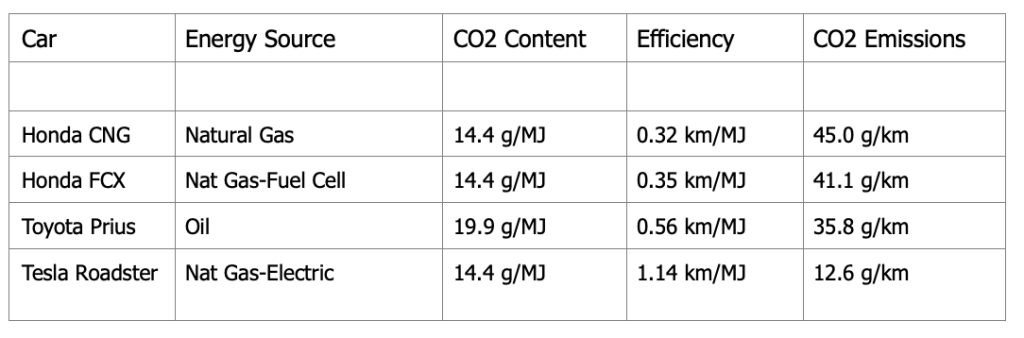
we will be offering a modestly sized and priced solar… This system can be… set up as a carport and will generate about 50 miles per day of electricity. If you travel less than 350 miles per week, you will therefore be “energy positive” with respect to your personal transportation… you will actually be putting more energy back into the system than you consume in transportation!”
However, Elon Musk does not mention the fact that:
- the move from mine-and-burn hydrocarbon economy towards a solar electric economy in itself requires a vast expenditure of fossil-fuel energy to re-purpose the entire worldwide industrial system, as well as build vast new energy grids for wind and solar energy, etc, simply to reduce CO2 emissions. A new industrial framework which in itself will still be very polluting to land, air, and water in virtually the same ways as the old framework as it creates more and more ‘product’ to be marketed and sold, such as electric cars, which we are now incorrectly told is okay because its ‘green product’;
 PERCEPTION RESET