
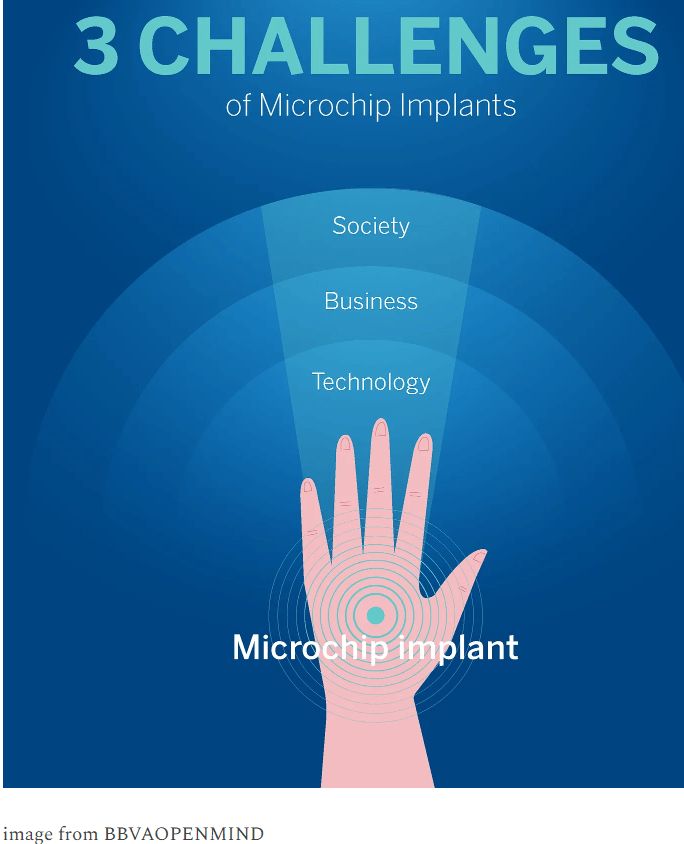
The dialogue pushing the IOT under the skin doesn’t address any of the intrusions, but deals only with the perceived convenience. How great for your government to know your whereabouts and activities at all times. Bathroom break? sleeping. going for a walk where the cameras can’t catch your mug? Don’t worry the database has your chip.
When you consider how permeable and vulnerable to hacking 5G is, then well you are hackable. The hackable human. How great it is for making payments? No really reaching into my purse and taking out my wallet was TOO MUCH, I needed digital slavery to compensate for that effort! How have people been living with wallets for all these years. The absolute oppression! We needed to be chipped.
Imagine your chip tells you to move to the front of the line. Great! burgers. No. It is your Medical Assistance in Death appointment. You’ve been decommissioned by the AI system who didn’t like productivity, your opinions online or how many times you chewed your food. Don’t you know there is a new bible about all these things.
The discussion
The Hill published this below article. BY ZHANNA L. MALEKOS SMITH, OPINION CONTRIBUTOR – 01/23/23 7:30 AM ET
“The novelty of replacing one’s “home key” with a microchip implant is gaining worldwide interest, but there’s another more compelling story under the surface. Why is this technology — an integrated circuit the size of a grain of rice — reviled by some and celebrated by self-proclaimed human cyborgs?
Arguably, William Shakespeare’s “Hamlet” offers the most elegant explanation: “Nothing is neither good nor bad, but thinking makes it so.” However, it would be prudent to tell Prince Hamlet that not all microchip implants are designed alike, and understanding the technological design enables one to better evaluate the competing viewpoints.
Today, more than 50,000 people have elected to have a subdermal chip surgically inserted between the thumb and index finger, serve as their new swipe key, or credit card.
In Germany, for example, more than 2,000 Germans have opted to receive these implants; one man even used it to store a link to his last will and testament. As chip storage capacity increases, perhaps users could even link to the complete works of Shakespeare.
Chip implants are just one of the many types of emerging technologies in the Internet of Things (IoT) — an expanding digital cosmos of wirelessly connected internet-enabled devices. Some technologists are worried, however, that hackers targeting IoT vulnerabilities in sensors and network architecture also may try to hack chip implants.
Radio-frequency identification (RFID) chips are identifying transponders that typically carry a unique identification number and can be tagged with user data such as health records, social media profiles, and financial information.
 PERCEPTION RESET