
The fog of war is an ever-present reality, defined by factual uncertainty brought on by the imperfect recollections of people subjected to stresses that are unthinkable in everyday life.
It is not uncommon for opposing parties to a conflict to put forward competing narratives about a given event, with each side believing itself to be accurate, yet their respective facts and the conclusions derived therefrom failing to align. However, sometimes one or both parties have something that they want hidden, an uncomfortable reality that should, from their perspective, never see the light of day. In that case, the fog of war becomes a deliberate smokescreen designed to mislead and misdirect an audience so that the truth is never found out. If only one party is participating in such a deception, the fact will generally find a way to reveal itself. But if both parties are engaged in deliberate obfuscation, it becomes virtually impossible to find the truth.
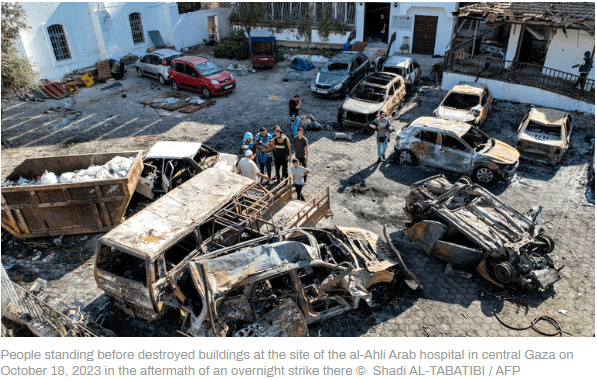
There has been a significant amount of finger-pointing about an incident at the Al-Ahli Arab Hospital in Gaza on the night of October 17, 2023. There is no disputing the fact that just before 7pm on October 17, a rocket of undetermined origin struck the parking lot of the Al-Ahli Hospital in Gaza. The exact number of casualties has yet to be determined. Still, most sources agree that several hundred Palestinians who had been forced from their homes by Israeli bombs and sought shelter on the hospital grounds were killed, with hundreds more injured.
Hamas immediately blamed Israel, a narrative quickly picked up by most media outlets worldwide, igniting a storm of outrage against Israel and, by extension, the United States. For its part, Israel vehemently denied it had any role in the attack. Instead, it shifted responsibility to the Palestinian Islamic Jihad (PIJ), an ally of Hamas that participated in the events of October 17 and which also conducts rocket attacks against Israeli cities from Gaza. The Israelis claimed that a rocket fired by PIJ malfunctioned and landed at the hospital.
Israel backed up its assertion by providing several pieces of information, including radar data used to track rocket and mortar fire coming out of Gaza, alleged intercepted communications between two unnamed Hamas fighters who corroborated Israeli claims that the source of the deadly explosion at the hospital was an errant PIJ rocket, and a series of videos from several sources which, from the Israeli perspective, appeared to show the malfunctioning PIJ rocket hitting the hospital grounds.
Israel, however, has a history of being less than truthful about incidents where its armed forces are involved in the deaths of innocent civilian populations. A case in point is the 1996 Qana massacre in southern Lebanon, where Israeli artillery fire killed scores of Lebanese refugees who had taken shelter in a bunker located on a base belonging to UN peacekeepers. The Israelis lied about every aspect of their involvement, most likely because they were trying to hide the involvement of a secret commando unit operating near the bunkers. Only later, when the United Nations published its own investigation into the incident, did Israel finally tell the truth – that the commando unit had been detected by Hezbollah fighters, and Israel fired artillery rounds in an indiscriminate manner to help bring the squad (commanded by future Israeli Prime Minister Naftali Bennett) to safety.
 PERCEPTION RESET