
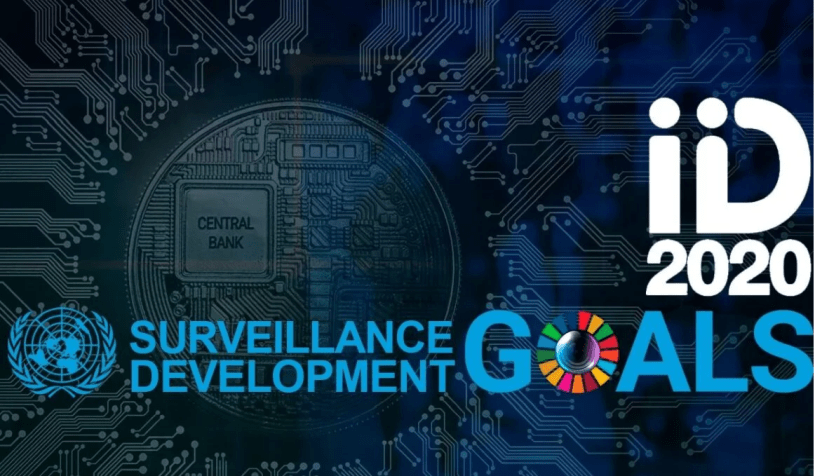
The United Nations claims that the purpose of Sustainable Development Goal 16 (SDG16) is to promote peaceful and inclusive societies and to provide access to justice for all. Hiding behind the rhetoric is the real objective: to strengthen and consolidate the power and authority of the “global governance regime” and to exploit threats—both real and imagined—in order to advance regime hegemony. In Part 2, Iain and Whitney examine the centrality of Digital ID (SDG 16.9) in this endeavour.
In Part 1 of our investigation into the United Nations’ (UN’s) Sustainable Development Goal 16 (SDG16) we revealed how the UN proclaims itself a “global governance regime.” We investigated the UN’s exploitation of so-called “human rights” as an authoritarian system of behavioural control permits, as opposed to any form of recognisable “rights.”
We examined how the UN uses what is calls the “policy tool” of human rights to place citizens (us) at the centre of international crises. This enables the UN and its “stakeholder partners” to seize crises as “opportunities” to limit and control our behaviour. The global public-private partnership (G3P), with the UN at its heart, redefines and even discards our supposed “human rights” entirely, claiming “crisis” as justification.
The overall objective of SDG16 is to strengthen the UN regime. The UN acknowledges that SDG16.9 is the most crucial of all its goals. It is, the regime claims, essential for the attainment of numerous other SDGs.
At first, SDG16.9 seems relatively innocuous:
By 2030, provide legal identity for all, including birth registration
But, as ever, when it comes to UN sustainable development, all is not as it initially appears.
SDG16.9 is designed to introduce a centrally controlled, global system of digital identification (digital ID). In combination with other global systems, such as interoperable Central Bank Digital Currencies (CBDCs), this can then be used to monitor our whereabouts, limit our freedom of movement and control our access to money, goods and services.
Universal adoption of SDG16.9 digital ID will enable the G3P global governance regime’s to establish a worldwide system of reward and punishment. If we accept the planned model of digital ID, it will ultimately enslave us in the name of sustainable development.
Digital ID As A Human Right
As we previously discussed, The UN underwent a “quiet revolution” in the 1990s. In 1998, then UN Secretary General Kofi Annan stated that “the business of the United Nations involves the businesses of the world.”
Government’s reduced role was to create the regulatory “enabling environment” for private investors, alongside taxpayers, to finance what would become SDGs. Using the highly questionable “climate crisis” as an alleged justification, in 2015, the UN’s Millennium Development Goals gave way to the 2030 Agenda for Sustainable Development.
On the 25th September 2015, UN General Assembly Resolution 70.1 (A/Res/70.1) formally established the SDGs by adopting the binding resolution to work towards “Transforming our world: the 2030 Agenda for Sustainable Development.”
As soon as the ink was dry on the resolution, the UN set about creating the enabling environment to encourage public-private partnerships to develop a system of global, digital ID. In May 2016, in response to SDG16.9, the United Nations Office for Partnerships convened the “ID2020 Summit – Harnessing Digital Identity for the Global Community.” This established the ID2020 Alliance.
The ID2020 Alliance is a global public-private partnership that has been setting the future course of digital identity since its founding. The global accountancy and corporate branding giant PwC was selected by the UN as the “lead sponsor” of the inaugural ID2020 summit in 2016. Excited about the opportunities digital ID would present, PwC described the ID2020 sustainable development objective:
[. . . .] to create technology-driven public-private partnerships to achieve the United Nations 2030 Sustainable Development Goal of providing legal identity for everyone on the planet. [. . .] Specifically, ID2020’s mission aligns with development target 16.9, “Legal identity for all, including birth registration”. Thirty percent of the world’s population, approximately 1.5 billion people, lack a legal identity, leaving them vulnerable to legal, political, social and economic exclusion.
Offering us digital ID to address so-called “economic exclusion,”—more on this shortly—the ID2020 Alliance duly launched in 2017 and set its Agenda2030 goal:
Enabling access to digital identity for every person on the planet.
You will note that the UN’s SDG16.9 makes no mention of global “digital ID.” Sustainable development, as it is presented to us, is nothing if not deceptive.
 PERCEPTION RESET