
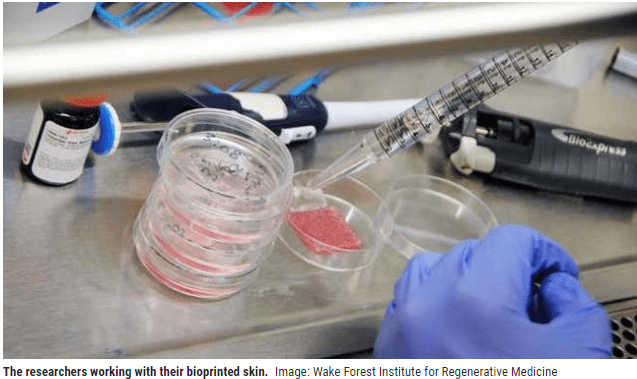
A team of scientists may have developed a breakthrough in wound repair: bioprinted skin that’s closer to natural skin than ever. In experiments with mice and pigs, the researchers found their skin was able to accelerate wound healing with less scarring than usual. It’s possible that this technology could one day help people completely heal from serious burns.
Skin is much more complex than what we see on the surface. There are three broad layers of skin, all with their own distinct anatomy. When we suffer severe enough wounds or skin conditions, our normal healing ability often isn’t enough to wholly restore its appearance and functioning. Temporary and permanent skin grafts (which move undamaged skin from somewhere else to the injury site) have allowed people to survive previously fatal wounds, but these usually don’t quite match the natural look of skin.
Ideally, it would be possible to treat these injuries by encouraging the full regeneration of damaged skin. Researchers at the Wake Forest Institute for Regenerative Medicine believe they might be able to accomplish this goal by turning to bioprinting technology, which uses 3D printing techniques to create more naturalistic tissue-like structures.
In their new research, published Wednesday in Science Translational Medicine, they detail the development of their unique bioprinted skin.
Bioprinting uses a combination of living cells, nutrients, and other biological materials to replicate tissue. In this case, the team was able to create bioprinted skin using all six major types of skin cells, along with specialized hydrogels that acted as a bio-ink. The resulting mix appeared to resemble full thickness human skin, complete with all three skin layers—an apparent first, according to the researchers.
 PERCEPTION RESET