
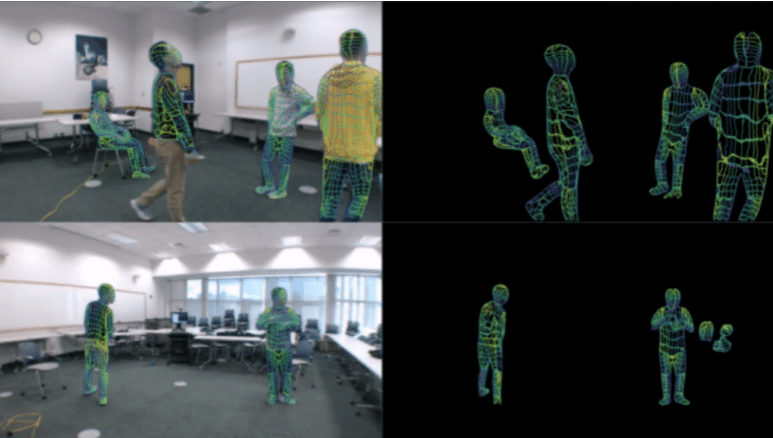
This should make your hair stand up! Your WiFi router and all your smart appliances (including your smart meter) create a dense web of EMF radiation in your home that can be used to see everything and anyone. A scanner used by someone outside your home can see through walls, spot people inside, see all your stuff, etc. Technocrats invent without conscience, ethics, or morality.
Note that the team at Carnegie Mellon University and the University of Waterloo “built the device using a store-bought drone and $20 of easily purchased hardware.” ⁃ TN Editor
When police suspected Danny Kyllo, an Oregon man, of growing cannabis in his home they drove to his house with a thermal imaging device to scan it. They found hot pockets in the house, which were used to obtain a search warrant and subsequently bust Kyllo.
Fortunately, a 5-4 Supreme Court decision ruled the scan an unlawful search under the Fourth Amendment, requiring a warrant the police did not obtain. Score one for privacy, but the government is about to have a far more controversial and dangerous tool at its disposal to monitor what’s going on inside your home.
Unlike a thermal imager, this device is already in your home – and you put it there.
How It Works
WiFi is electromagnetic waves in the 2.4 and 5 GHz ranges. It’s the same thing as the light you see, only it can penetrate walls due to its much longer wavelength. Just like light (and echolocation) these waves also reflect off various surfaces and, when reconstructed properly, can be used to create an image.
Development of this technology goes back at least as far as July 2005, where researchers claimed at an IEEE Symposium that they had created an ultra-wideband high-resolution short pulse imaging radar system operating around 10 GHz. The applications for which were explicitly for military and police use, providing them with “enhanced situation awareness.”
A few years later, in 2008, researchers at UC Santa Barbara created an initial approach for imaging with WiFi that they presented at IEEE ACC 2009. A year later they demonstrated the feasibility of this approach.
The Race is On
Sensing the potential of this new surveillance technology, other researchers began piling on. Progress was initially slow but, in 2017, two researchers in Germany demonstrated the ability to do WiFi imaging using techniques borrowed from the field of holography. According to Philipp Holl, an undergrad student and lead study author who worked with Friedemann Reinhard of the Technical University of Munich to develop the new method, “The past two years have seen an explosion of methods for passive Wi-Fi imaging.”
At the time, the technology could only make out rough shapes of things. “If there’s a cup of coffee on a table, you may see something is there, but you couldn’t see the shape,” Holl says, “but you could make out the shape of a person, or a dog on a couch. Really any object that’s more than 4 centimeters in size.”
 PERCEPTION RESET