
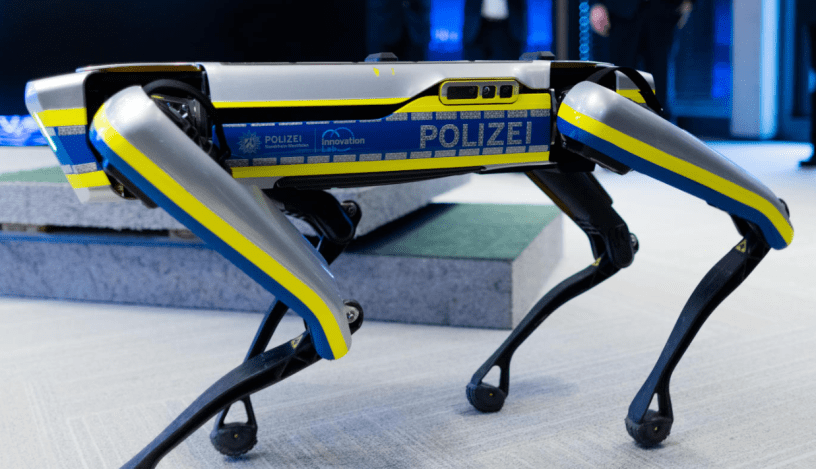
IN LATE MAY, after months of debate, the Los Angeles City Council approved the donation of a four-legged, doglike robot to the nation’s third-largest police department. The approval was granted at a public meeting that was interrupted at times by shouting, applause, banners such as “No Robot Dogs,” and the ejection of disruptive protesters, according to The Los Angeles Times.
In the end, the council voted 8 to 4 to accept the nearly $280,000 in-kind gift from the Los Angeles Police Foundation of the robot manufactured by Boston Dynamics, a Massachusetts-based robotics firm that is the global leader in developing quadruped robots for policing and surveillance.
The Boston Dynamics model given to the LAPD — named “Spot” by its manufacturer — is roughly the size of a golden retriever, weighing about 70 pounds and standing about 2 feet tall when walking. The robot is designed to be either remote controlled or fully autonomous. It can climb stairs and open doors. The robot can be customized to detect hazardous substances like carbon monoxide or some combustible gases. The various payloads available include sensors, cameras, and microphones, and can be customized with thermal imaging, among other features.
The Los Angeles City Council’s move to accept the donation will require quarterly reports on the deployment and use of the robot. Its sign-off was necessary as a result of a recent state law — Assembly Bill 481 — that requires police departments to seek approval and outline use policies before acquiring military-grade hardware.
But apparently this is not the case in other cities, including New York, where the police department also announced plans this spring to deploy two Boston Dynamics robots, paid for with asset forfeiture funds, as well as a new surveillance robot known as the K5. A number of law enforcement agencies around the country are acquiring such robots with little transparency, critics say.
 PERCEPTION RESET