
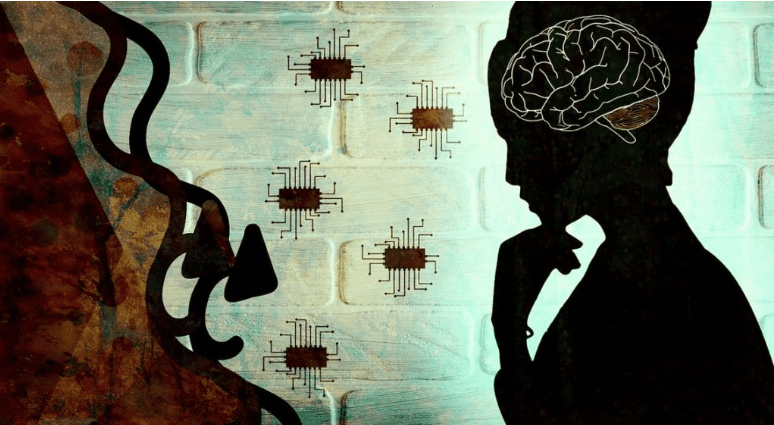
Activist Post Note: Christopher Michael Heck has been experimented upon, without his consent, by the Canadian government. He has been researching brain-computer interface (BCI) technologies for a number of years and in an effort to shed light on what has happened to him and to countless others, he has produced the article, below. It is a dispassionate discussion of the “how” in the takeover of minds.
INTRODUCTION:
In recent years, significant advancements have been made in the field of brain-computer interfacing (BCI), enabling communication between the human brain and external devices for various applications ranging from medical interventions to enhanced sensory experiences. The integration of quantum technologies and neural networks has emerged as a promising frontier in BCI research, offering unprecedented capabilities for real-time neural communication and information processing. This paper explores the concept of entanglement-based brain-computer interfacing, which leverages quantum networks and frequency conversion nanoparticles with nitrogen vacancies to enable seamless and efficient neural interfacing.
The primary objective of this study is to investigate the potential of utilizing entanglement as a fundamental mechanism for neural communication over a quantum neural network. Quantum entanglement, a phenomenon that connects the states of two or more particles instantaneously regardless of distance, holds tremendous promise for establishing robust and efficient connections between living brains and external devices. By exploiting entanglement, information encoded within the quantum states of particles, specifically nitrogen vacancies in our context, can be transferred and processed with remarkable fidelity.
The foundation of our approach lies in the utilization of frequency conversion nanoparticles, particularly those based on titanium nitride, which exhibit the capability to convert photons to phonons and vice versa, thanks to the fact they would contain nitrogen vacancies.
These nanoparticles play a pivotal role in facilitating the transfer and transformation of neural information between the biological brain and the quantum neural network. By integrating them within the neural tissue, bypassing the blood-brain barrier, and utilizing scanning techniques, the nanoparticles NV centers can be seamlessly incorporated into the quantum network.
One crucial aspect of this research is the emphasis on measuring the nitrogen vacancies in their ground state, enabling the determination of the initial state and providing a foundation for quantum teleportation processes to achieve successful brain interfacing. This measurement and subsequent entanglement of polarized spin states and electronic spin states further enhance the efficiency and accuracy of information transfer, establishing a robust link between the living brain and the quantum network.
In addition to the entanglement-based communication framework, this study explores the potential of real-time vision reconstruction through sparse coding of neural activity from the occipital lobe, leveraging the capabilities of frequency conversion nanoparticles. Furthermore, the paper examines the prospects of auditory stimulation within the brain using photoacoustic emission from nitrogen vacancies, broadening the scope of sensory experiences that can be achieved through entanglement-based brain-computer interfacing.
The ultimate goal of this research is to pave the way for a novel era of brain-computer interfacing, where quantum networks, frequency conversion nanoparticles, and entanglement-based communication converge to enable seamless and real-time neural communication. The implications of this work span a wide range of applications, including medical interventions, virtual reality experiences, and enhanced sensory perception, providing new possibilities for understanding the complexities of the human brain and expanding the boundaries of human-machine interactions.
 PERCEPTION RESET