

Last week, the BBC reported that seawater along the tip of Florida had exceeded “hot tub” temperatures of 37.8°C (100°F) in recent days, “making it potentially the hottest ever measured”. The Guardian was in fine alarmist form noting that the Florida recording posed a threat to human food supplies and the livelihoods of those working in the water. Similar hysteria was to be found across most of the mainstream media. Alas, curiously missing from all this excitable coverage was a note that just 48 hours later the temperature plummeted to around 85°F.
The reading was taken from a buoy in Manatee Bay which is managed by the Everglades National Park, and located north of Key Largo. The upper left graph below shows that the temperature moved between 90-101°F on consecutive days, then fell away rapidly to around 85°F.
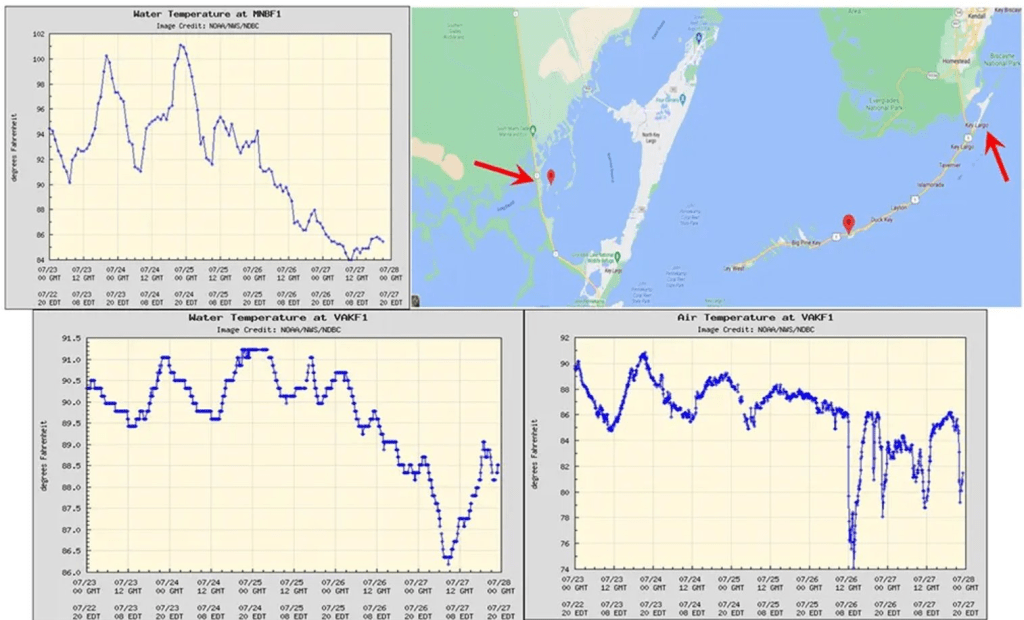
Examining the ‘record’ on the climate site Watts Up With That?, the former ecology lecturer Jim Steele observed that water temperatures were being driven by dynamics other than rising CO2. Steele noted that the Manatee Bay buoy measuring the water temperature was in a small embayment surrounded by landform and this forms a natural hot tub. Low winds and a high pressure system further helped heat the bay, while muddy waters darkened the water enhancing solar heating.
Steele noted that the science of solar ponds has shown that when fresh water overlayed saltier water, heat gets trapped, and temperatures can be as much as 60°F hotter than the surface at depths between five and 10 feet.
To maintain the “crisis hoax”, Steele suggests it’s also important to ignore conflicting data. Southern Florida has several buoys, some measuring water temperature, some air and some both. Just 56 miles to the south-west of Manatee Bay, the VAKF1 buoy measured water temperatures that were 10°F lower than Manatee Bay on those same days, as shown in the lower left graph (above), which then cooled to 86°F. Manatee Bay lacked air temperature data but VAKF1 reported a high air temperature of 91°F (lower right graph) which then cooled to the low 80°Fs, even dipping to 76°F. “These air temperatures don’t even approach being unprecedented,” said Steele.
Jim Steele has a lifetime’s experience in working for environmental education projects. For 25 years he ran the Sierra Nevada Field Campus for San Francisco State University. As part of one monitoring project, he studied the effect of regional climate change on bird populations in the Sierra Nevada.
 PERCEPTION RESET