
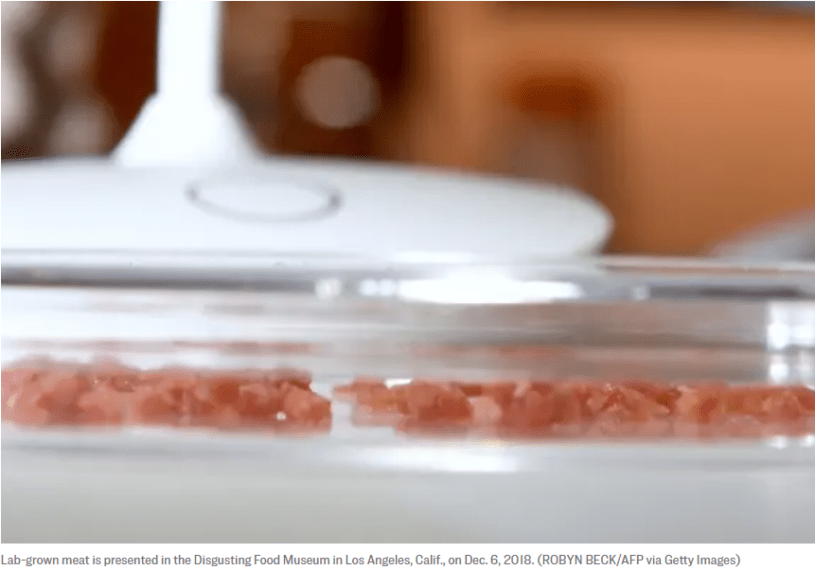
Lab grown “meat” may be potentially worse for the environment than actual beef and may have an even larger carbon footprint, according to a recent study.
This follows the USDA’s approval of the FDA’s decision on June 21 to greenlight the sale of lab-grown meat to American consumers.
GOOD Meat, a company that grows cell-based meat in its labs, announced in June the USDA’s approval to sell its products.
Advocates of lab grown meat, which is cultured from animal cells, has been lauded by activists of being more environmentally friendly than beef, as it uses less land, water, and produces no greenhouse gases, compared to raising cattle.
The United States joins Singapore as the only country approving “cell-cultured” meat for human consumption
Only chicken has passed the official government approval process for now, with a “no questions” letter that grants permission for distribution, but pork and beef will have to wait.
However, a pre-print study by researchers at the University of California, Davis, have found that the environmental impacts of lab-grown or “cultivated” meat, are likely to be “orders of magnitude” higher than its natural counterpart, based on current and near-term production methods.
Fake Meat May Actually Require More Energy Than Organic Meat
Amy Quinton from UC Davis Department of Food Science announced preliminary results from the study on the environmental impact of lab grown meat in a May 22 report.
The researchers assessed the amount of energy needed and the greenhouse gases emitted to create artificial beef and compared it with traditional organic meat production.
It was found that scaling up production using current lab methods was highly energy intensive.
Lab-grown meat is produced through the use of highly refined or purified growth media, which are the ingredients used to make animal cells multiply and is similar to how biotechnology firms make their drugs.
The UC Davis team found that the global warming potential of lab-based meat using this process, is four to twenty-five times greater than the average for retail beef.
“If companies are having to purify growth media to pharmaceutical levels, it uses more resources, which then increases global warming potential,” stated UC Davis doctoral graduate Derrick Risner, the study’s lead author.
“If this product continues to be produced using the ‘pharma’ approach, it’s going to be worse for the environment and more expensive than conventional beef production,” he added.
 PERCEPTION RESET