
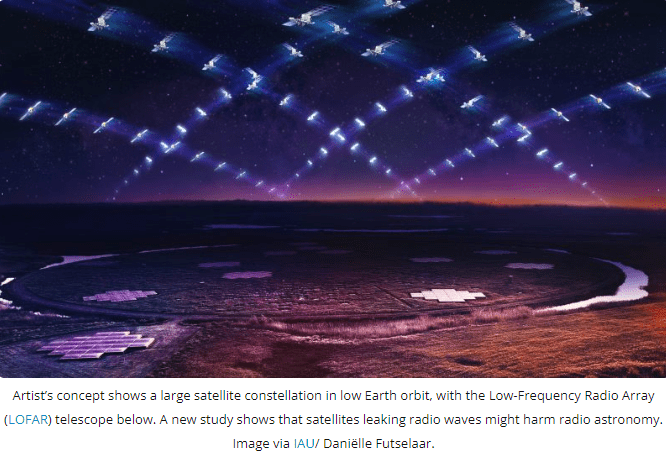
SpaceX satellites leaking radio waves
On July 5, 2023, astronomers from various institutions announced that their new study has detected “unintended electromagnetic radiation” emanating from the onboard electronics of the controversial Starlink satellites. They said this measurable leakage from the satellites – which make up SpaceX’s giant satellite constellations – might already be interfering with the science of radio astronomy.
These scientists were working under the auspices of the International Astronomical Union (IAU) Center for the Protection of the Dark and Quiet Sky from Satellite Constellation Interference (CPS).
The scientists confirmed the radiation leakage in observations made with the LOFAR telescope, a low-frequency radio array in the Netherlands.
The peer-reviewed journal Astronomy and Astrophysics accepted the study for publication on May 12, 2023.
Pretty proud of my response to this Elon fanboy in a Reddit thread about mega constellation effects on radio astronomy pic.twitter.com/GNZppDoJ5c
— Yvette Cendes (@whereisyvette) July 11, 2023
Musk’s SpaceX Starlink satellites
For the study, the scientists observed 68 Starlink satellites. While the researchers focused on Starlink satellites because they dominate the category of manmade objects in orbit around Earth, they recognize that there are other large satellite constellations. Their statement said:
The authors expect to detect similar unintended emissions from other low-Earth-orbiting satellites, and further measurement work is already planned focusing on other satellite constellations.
Lead author Federico Di Vruno of the IAU said:
This study represents the latest effort to better understand satellite constellations’ impact on radio astronomy. Previous workshops on Dark and Quiet Skies theorized about this radiation, and our observations confirm it is measurable.
Listening to the sky
Radio astronomers detect faint radio signals from the sky to learn more about dying stars, the black hole at the center of our galaxy, and much more. On Earth, radio astronomers have always had to contend with humanmade radio signals, and, as a result, have often built their telescopes in locations far from interference. In fact, there are even plans to build a radio telescope in a crater on the far side of the moon.
But it’s becoming more clear that Earth-based radio telescopes are facing a growing problem of satellite interference. While all astronomical observatories have to deal with the issue of satellites crossing the field of view of their instruments, radio astronomers say the problem is particularly acute for them.
A satellite’s radio signal is much, much stronger than the faint background sources that radio astronomers study. And a satellite doesn’t have to pass right in front of the object of study to cause interference. Satellite sources in a radio telescope’s “peripheral vision” also interfere.
 PERCEPTION RESET