
- According to Our World in Data, in 2017, for the first time in history, the number of people older than 64 surpassed the number of children under 5
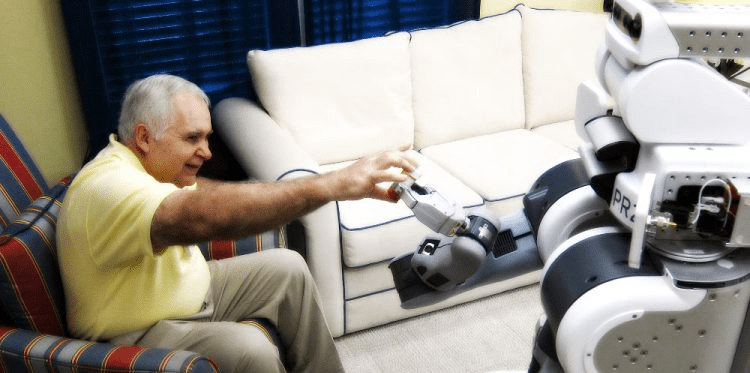
- “Age tech,” from eldercare robots to surveillance devices, is the technocrats’ coveted answer to the problem of the growing number of people with disability and dementia
- This demographic imbalance is a result of both the industrial-scale poisoning and the deliberate campaign to reduce fertility, detailed in no uncertain terms in the Kissinger report
- To confuse us more, the propagandists are coming up with a whole new language to describe our elders and their needs
This story is about a new market grab and a new brand of hype. Let us take a good look at the shiny marketing brochure for “eldercare technology.” It seems like the important investors, perched high, are very excited about the opportunity to squeeze more profits out of the demographic and health crises that they have previously created with their own hands — and to “monetize” the elders like captured pets, while pretending that they are doing it for the elders’ own good.
Ehm, who are our house experts on monetizing manufactured woes? The WEF folks! In 2021, they inquired: “Ageing: Looming crisis or booming opportunity?” Seemingly, the decline in health and fertility rates is a looming crisis for us, lowly peasants — but it sure is a booming opportunity for their crew!
The proverbial owners of everything are saying that “by 2050, the number of adults over the age of 65 globally will double, reaching a staggering 1.6 billion, with the largest growth in the developing world. This growth will be one of the greatest social, economic, and political transformations of our time, that will impact existing healthcare, government and social systems.” (Yay, new normal, hooray!) They continue:
“We can begin to make investments in our support systems (enabled and scaled by technology) that encompass a coordinated response from governments, society, academia, and the private sector.
To truly bring the holistic services needed to market, device makers, developers, enterprises such as retirement homes and insurance companies, civil society, policy-makers, and academia should come together to develop a unified platform that includes Internet of Things and Artificial Intelligence [emphasis mine].”
Sure, when one has a hammer, everything is a nail! Meanwhile, the WEF story lists the following areas of eldercare technology:
- Robots
- Telemedicine
- Tablets for communication and entertainment
- “Smart” platforms that integrate electronic medical records (EMRs) and electronic health records with AI and analytics (yay!!)
- Wearables
- Voice, touch, motion, and other assistive technologies
- Connected IoT devices and sensors
- Technologies for safety (monitoring and alert devices)
- Sensory aids (e.g., hearing devices)
- Gig economy services (e.g., meal delivery)
- Self-driving cars
Oh and who is literally investing in this? According to the WEF, Microsoft does. “For example, Microsoft Cloud for Healthcare helps manage health data at scale by providing personalized care, transforming data into patient insights, enabling virtual care and care team collaboration, optimizing treatment by combining IoT and analytics, and promoting data interoperability.” Oh, shocking. But at least, it’s for our own good!
 PERCEPTION RESET