
NASA usually has a reassuringly close eye on asteroids that come anywhere near our planet, but one has managed to slip through the net.
An asteroid called 2023 NT1 reached as close as around 62,000 miles from Earth – about a quarter the distance between Earth and the moon – on July 13.
But it wasn’t until two days after its close approach that NASA scientists detected it, because it was coming from the direction of the sun and was obscured by light.
2023 NT1, which is now moving away from Earth at a speed of about 25,000 miles per hour, is up to 200 feet in diameter – bigger than the Leaning Tower of Pisa.
This also makes it bigger than the 60-foot Chelyabinsk meteor, which injured more than 1,600 people when it entered Earth’s atmosphere in 2013.
According to data from NASA and the International Astronomical Union, 2023 NT1 made its closest approach to Earth at 10:12 UTC (11:12 BST) on July 13.
The first reported observation two days later was by ATLAS South Africa, a four-telescope system dedicated to spotting hazardous asteroids.
At up to 200 feet (60 metres) across, 2023 NT1 could be larger than the asteroid that caused Meteor Crater in Arizona, said amateur astronomer Tony Dunn on Twitter.
The historic impact crater near Flagstaff, around 3,900 feet in diameter, is thought to have been caused by a rock that hit Earth around 50,000 years ago.
Despite its close approach, 2023 NT1 isn’t large enough to be considered ‘potentially hazardous’.
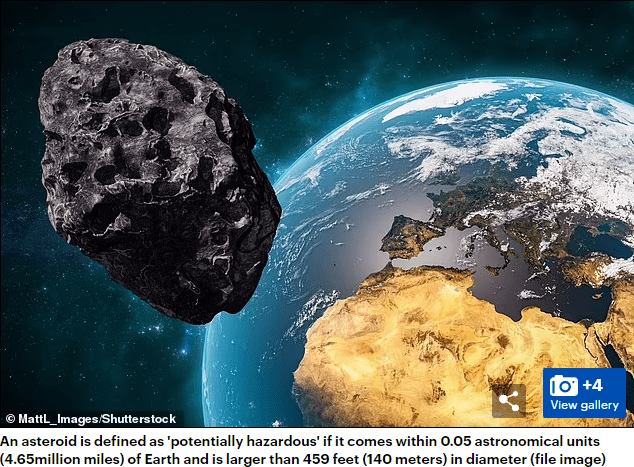
An asteroid is defined as ‘potentially hazardous’ if it comes within 0.05 astronomical units (4.65 million miles) of Earth and is larger than 459 feet (140 meters) in diameter.
At a maximum of 200 feet, 2023 NT1 only fits one of those criteria.
Thankfully 2023 NT1 passed by without issue, but the episode highlights that we have a problem spotting some asteroids due to the glare of the sun.
 PERCEPTION RESET