

Our governments intend to transfer decisions over our health, families, and societal freedoms to the Director General of the World Health Organization (WHO), whenever he or she declares it necessary. The success of this transfer of power depends on public ignorance of its implications, and of the nature of the WHO itself and its recent pandemic policy reversals. When the public understands, then its leaders are more likely to act in their interests rather than against them.
In late 2019, the WHO issued new recommendations for pandemic influenza. Influenza spreads by the same mechanism as Covid-19 (aerosols), with a similar mortality in most people. The WHO stated that it is “not recommended in any circumstances” to undertake contact tracing, quarantine of exposed individuals, entry and exit screening, and border closures. They envisioned that in a severe pandemic it may be necessary to close businesses for up to seven to ten days.
The WHO cautioned against strict measures because they would have minimal impact on the spread of an aerosolized respiratory virus while inevitably increasing poverty, especially harming low-income people. Poverty makes people die younger and is a major killer of babies in low-income countries.
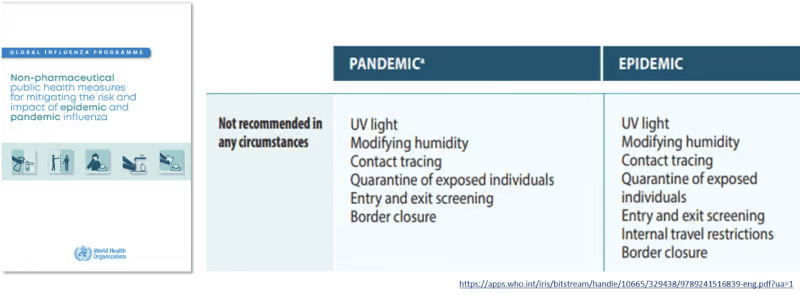
A few months later, the WHO advocated for everything they had previously advised against, to combat Covid-19. This reversal in their recommendations had the effect they had predicted; increasing poverty and shortening life expectancy, particularly amongst the world’s poorest and most vulnerable, while having minimal overall impact on virus spread.
While the WHO’s 2019 recommendations were based on the assessment of decades of knowledge by an expert panel, its Covid-19 lockdown recommendations were based solely on reported experience from one city in China. Their new source of knowledge had, a few weeks earlier, stated that the new virus had no human-to-human transmission. This was followed by apparent propaganda taken up by the world’s media of people dropping dead in the streets.
It is vital to understand what drove this reversal of WHO policy, and to detail its harm. International public health priorities are currently being upended with the specific aim of allowing the WHO to do this again, harder and more frequently. In May 2024 our countries will vote to allow a single person to dictate border closures and quarantine, and require medical examinations and vaccination of their citizens. They will agree to censor those who protest. Our governments will undertake to make this individual’s recommendations regarding our rights to family life, work, and school effectively binding.
In promoting lockdowns, the WHO was not only following China, but a group of powerful Pharma-related interests who have been pushing these approaches for over a decade. They have established public-private partnerships such as the Swiss-based CEPI, channeling taxpayer funding to promote their authoritarian approach to public health. In October 2019, a meeting called Event-201 was convened by the Bill & Melinda Gates Foundation, World Economic Forum and Johns Hopkins School of Public Health, including the WHO, China CDC and others, to run simulations of such approaches for a hypothetical coronavirus outbreak. At this time, Covid-19 virus must already have been circulating well beyond China.
Whilst establishing this influence over public health policy, Pharma and their private investors increasingly funded the WHO itself, now providing about 25 percent of its budget. This funding is ‘specified,’ meaning the funder decides how and where it is spent. Certain governments now also ‘specify’ most of their funding, leading to over 75 percent of the WHO’s activities being determined by the donor. Germany stands out as the second highest national donor after the USA, also being a major investor in BioNTech, Pfizer’s Covid-19 mRNA vaccine developer.
 PERCEPTION RESET