
The World Economic Forum’s (WEF) carrot or stick approach to climate policies is virtually the same as it was for COVID.
From COVID contact tracing and vaccine passports to carbon footprint tracking and measuring, the end goal is practically identical — to develop the technological foundation to track and trace every person and object on the planet in order to incentivize, coerce, or otherwise manipulate individual human behavior.
Take the latest WEF Annual Meeting of the New Champions, aka “Summer Davos,” that took place in China last month as the latest example of unelected globalists trying to nudge people towards changing their behavior by tracking the carbon footprints of the products they use.
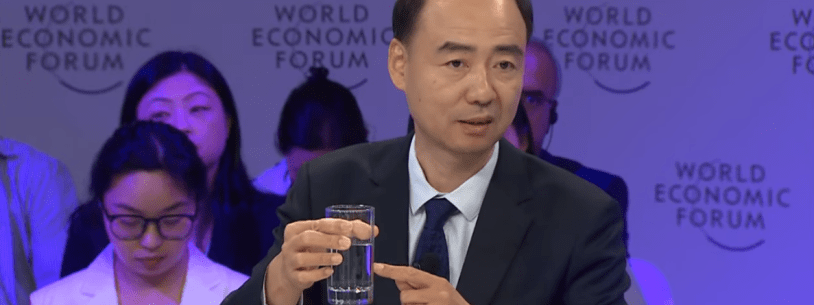
Speaking during a session called “How to Stay Within Planetary Boundaries — Carrot or Stick?” Ma Jun, the director of the Chinese NGO Institute of Public and Environmental affairs, said that the Chinese people were aware of tangible things like air and water pollution that they could experience with their own senses, but were less aware of climate issues (i.e. their carbon footprints), which were less tangible, but that measuring carbon footprints could be the solution.
“On the climate side [China] is still lagging behind regions like Europe […] which can support very, very tough public policy on the climate side” Ma Jun, WEF, 2023
“In China, people’s awareness on the ecological side and on the pollution control side is much higher than the climate side,” said Jun, adding, “On the climate side, it’s still not quite there. We’re still lagging behind, say, regions like Europe, which can have such a high level of public awareness, which can support very, very tough public policy on the climate side.”
China had one of the toughest, most Orwellian responses to COVID while simultaneously rounding up its Uighur population for internment in “re-education camps,” but this man is saying that the Chinese Communist Party (CCP) can’t support tough policies on climate?
At any rate, Jun went on to explain, “In China, the government have created this 30-60 commitment, but people haven’t really linked their daily lives with that, so how do we create those links?
“It’s not like smog; it’s not as palpable as the water pollution and air pollution, so we need to create those [links].”
To further his point, Jun held up a cup of water to explain how its carbon footprint could be tracked and traced from cradle to the gate and on to the grave.
He said that with emerging technology, people could take a picture of a cup and find all kinds of information about its entire life cycle while also measuring its carbon footprint.
“Any package, pallet or container can now be equipped with a sensor, transmitter or radio frequency identification (RFID) tag […] In the near future, similar monitoring systems will also be applied to the movement and tracking of people” Klaus Schwab, The Fourth Industrial Revolution, 2017
WEF founder Klaus Schwab predicted this in his 2017 book “The Fourth Industrial Revolution.”
There, Schwab wrote, “Any package, pallet or container can now be equipped with a sensor, transmitter or radio frequency identification (RFID) tag that allows a company to track where it is as it moves through the supply chain—how it is performing, how it is being used, and so on.”
“In the near future, similar monitoring systems will also be applied to the movement and tracking of people,” he added.
Schwab’s words would turn prophetic during the pandemic.

What started with digital contact tracing and surveillance in 2020 quickly morphed into vaccine passports, which paved the technological framework to push forward digital identity schemes by way of a trojan horse in early 2021 — all of which were championed by the WEF and its partners.
Vaccine passports, according to the WEF, “serve as a form of digital identity” while a “digital identity determines what products, services and information we can access – or, conversely, what is closed off to us.”
While Schwab mentioned RFID chips as a technology by which people and goods would be tracked and traced, Jun said that carbon footprint tracking could be done with smartphones, AI, big data, and Internet of Things (IoT) devices.
 PERCEPTION RESET