
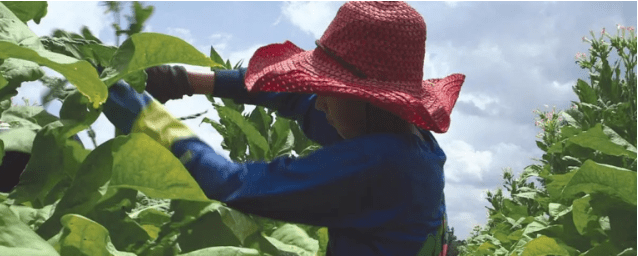
A 2016 film titled ‘Genetically Modified Children’ exposed how Philip Morris and Monsanto have exploited impoverished farmers since 1966 when the Argentinian government authorised the use of genetically modified (“GM”) crops to withstand Monsanto’s Roundup weedkiller. As a result, an increasing number of children are being born with severe birth defects and deformities in Argentina.
Low-income tobacco farmers face skyrocketing cancer rates with more devastating repercussions affecting their children: severe physical deformities and mental disabilities. Choosing between poverty or poison, Latin American growers have no choice but to use harmful chemicals such as glyphosate, in Monsanto’s Roundup, and Bayer’s Confidor, if they want to certify and sell their crops to Big Tobacco.
As patent and regulatory laws continue to favour the profits of Monsanto and chemical companies, the tobacco makes its way into the hands and mouths of consumers worldwide in Philip Morris tobacco products, while the poisons used to harvest the crops contaminate the farmers’ blood and are modifying the human genome, creating genetically modified children.
The film interviews Dr. Hugo Gomez Demaio and Dr. Mario Barrera, who are dedicated to highlighting and treating the link between agrochemicals and birth defects. It features anti-agrochemical activist Sofia Gatica, who is renowned for her work in tracking abnormal rates of cancer, kidney disease and other ailments linked to aerial spraying of glyphosate on GM soy crops.
Genetically Modified Children (Documentary, 2016) (55 mins)
GM Children: Film Unveils “Monstrous” Child Deformities
Note: This article was originally published on 25 August 2018.
The shocking film ‘Genetically Modified Children’ unveils the horrors of decades of chemical-intensive agricultural practices in Argentina, where the majority of crops are genetically modified (“GM”) and routinely doused in dangerous agrochemicals, and the chokehold big tobacco companies such as Philip Morris and chemical and seed giants have on poverty-stricken farmers desperate to earn a living.
The film, produced by Juliette Igier and Stephanie Lebrun, shows the devastating health effects the region’s agricultural sector is having on children,1 an increasing number of whom are being born with monstrous physical deformities. Some of the children’s cases are so severe that, without medical intervention, will result in death before the age of 5.
The film begins with the crew travelling from North Argentina in the Province of Misiones to the Brazilian frontier, an agricultural region that was one of the nation’s first to begin growing genetically modified organisms (“GMOs”) in the mid-1990s.
Featured in the film is Ricardo Rivero, the regional head of the local electricity company. He learned that the reason families cannot pay their bills is because often they are taking care of a sick or handicapped child, and receiving no assistance from the Argentinian government.
The film shows them visiting the humble home of a tobacco farmer where they meet Lucas Texeira, a 5-year-old boy with an incurable genetic skin disease. The family believes it was caused by the mother’s exposure to Monsanto’s Roundup weedkiller early on in her pregnancy. No one told her it was toxic, she says.
The genetic mutation that caused her son’s condition left him with no pores in his skin, which means he doesn’t perspire. The heat from his body stays inside, causing him severe and painful itching that leads to frequent crying spells. Mr. Texeira expresses his sadness over Lucas’ condition, as well as his fears that he could have another child in the future with a similar deformity.
 PERCEPTION RESET
Love this
This article sheds light on the devastating effects of chemical-intensive agriculture and the exploitation faced by impoverished farmers. It is important to raise awareness about the link between agrochemicals and birth defects, and support efforts towards healthier and more sustainable farming practices.
Geraint
Feel free to visit my hub page -https://lllpg.com/gmhmxxrf/
LikeLike
Thank you for commenting. I update my website with new information daily. Take care!
Sean
LikeLike