
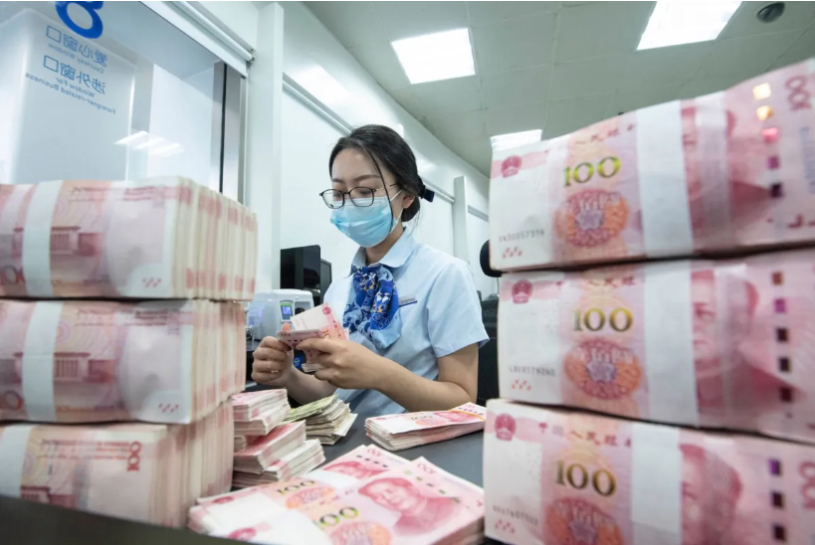
The Chinese regime is hiding trillions of dollars in “shadow reserves,” according to an economist and former Obama-era Treasury Department official.
Mr. Brad Setser, who served on President Joe Biden’s 2020 transition Agency Review Team, recently warned that China possesses far more foreign exchange reserves than what the regime is reporting. He estimated in The China Project that Beijing likely has roughly $3 trillion “hidden,” something that could threaten the global economy in the future.
“China is so big that how it manages its economy and currency matters enormously to the world,” he said on June 29. “Yet over time, the way it manages its currency and its foreign exchange reserves has become much less transparent—creating new kinds of risks for the global economy.”
According to data from the State Administration of Foreign Exchange (SAFE), China officially has $3.204 trillion in foreign assets on the books as of April 2023. Beijing’s war chest consists of cash, bonds, bank deposits, gold, and other currencies.
The former deputy assistant Treasury secretary for international economic analysis noted that the country’s sudden pause in its reporting activity was a key hint at the present state of China’s reserves.
From 2002 to 2012, the Chinese regime’s forex reserves steadily increased amid the People’s Bank of China (PBoC) acquiring U.S. dollars to prevent the yuan from appreciating too much and ensuring exports remained cheap. However, in the last decade, the nation’s reserves ceased growing, despite a record trade surplus.
In the first five months of 2023, China’s trade surplus with the United States surged nearly 28 percent year-over-year to $359.48 billion. Moreover, it is estimated that there is a gap of about $200 billion between China’s goods surplus in the balance of payments and the goods surplus that Beijing’s customs reports in the official data.
Mr. Setser, now the senior fellow for international economics at the Council on Foreign Relations (CFR), believes officials are preventing data from appearing on the central bank’s balance sheet by relying on state-run banks and sovereign wealth funds.
“Just as China has ‘shadow banks’—financial institutions that act like banks and take the kind of risks that a bank might normally take but aren’t regulated like banks—China has [what] might be called ‘shadow reserves.’ Not everything that China does in the market now shows up in the PBoC’s balance sheet,” he wrote, adding that officials use the state banking system to shield these reserves from public viewing.
Ultimately, this could turn out to be a significant problem for the global economy and pose a major risk, considering how crucial China is for the international marketplace, Mr. Setster said.
The State Administration of Foreign Exchange did not respond to a request for comment.
 PERCEPTION RESET