
Reptilian beings have been depicted throughout history and are chronicled by cultures around the world. Seven thousand-year-old human-serpent statues were uncovered in Mesopotamia. Ancient Sumerians spoke of the Anunnaki, an extraterrestrial race said to have influenced mankind. Asian mythology described dragon emperors who ruled the land. Indigenous South Americans worshipped Quetzalcoatl, a snake-god. In modern times, supposed alien abductees have repeatedly witnessed lizard-like humanoids. Conspiracy theorists claim the world is run by an elite group of shapeshifting reptiles. While many scoff at the idea of aforementioned entities, some researchers argue that had dinosaurs survived they would have evolved into these very creatures.
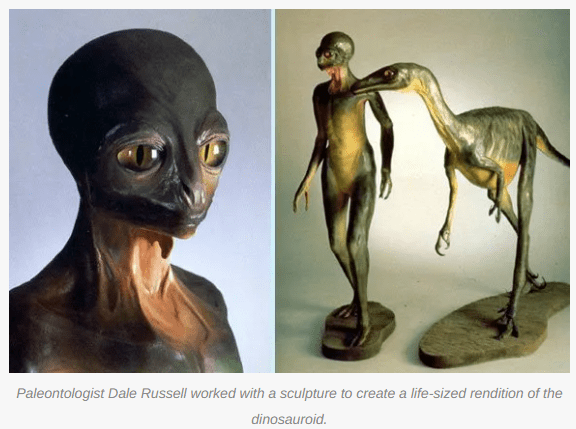
Dale Russell is an American-Canadian geologist, college professor and paleontologist. He first proposed the “dinosauroid” theory in 1982 after an extensive decades-long investigation of the Troodon. These prehistoric animals had large eyes with binocular-like vision and abnormally large brains. Their IQs measured six times higher than other dinosaurs. Troodontids possessed semi-manipulative fingers and could grasp objects with their hands. Russell’s extensive studies suggested they were progressing into highly intelligent lifeforms. In fact, the enigmatic species would have shared an eerily close resemblance to modern humans. Artist Ron Seguin created a life-sized sculptural rendition under Russell’s guidance and the result is quite unsettling.
Betsey Lewis, author of Ancient Serpent Gods: The Alien Connection to Reptilian Dinosaurs, theorized that not all sentient dinosaurs were obliterated in the K-T mass extinction. She speculated some retreated underground and lived in subterranean lands deep beneath the Earth. This interpretation coincides with the 1999 transcription “Lacerta Files” which stated opposable thumbed Iguanodons survived annihilation. Eventually, the bipedal brutes evolved into Saurians, a supposed type of reptoid which dwell underground. Saurians appear in Egyptian and Mayan inscriptions as well as religious writings including the Hebrew Bible, Vedas and Quran.
In 1968 paleontologist Robert T. Baker published a paper on endothermy and concluded that dinosaurs were warm-blooded, highly intelligent and walked upright. Eighteen years later he released The Dinosaur Heresies. His book suggested large herbivores would require consistent body temperatures (above the surrounding environment) for their hearts to pump blood upwards to their highly elevated heads. Such metabolisms are also a developmental asset for predators. Baker’s thesis coincides with Lacerta’s assertion of bipedal reptilian races average core temperatures measuring 86 to 91°F. Should this be true, it is feasibly conceivable that the beasts could endure sub-terrestrial environments.
 PERCEPTION RESET