
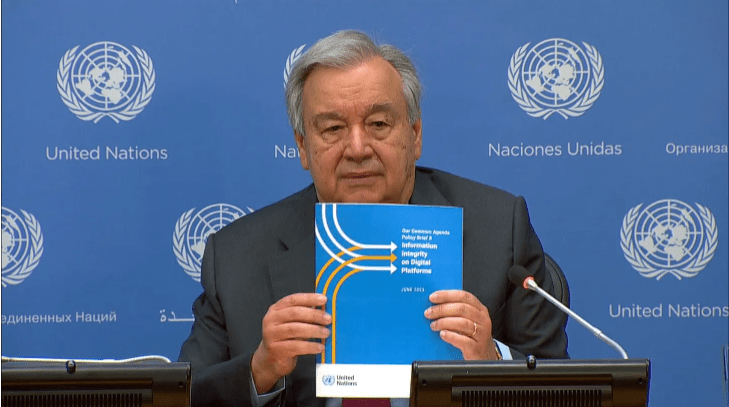
The United Nations Policy Brief Information Integrity on Digital Platforms (a part of the Secretary-Generals vision for the future of global cooperation – Our Common Agenda) was released June 12th. The report prescribes an Orwellian future with tight control of information to tackle the “existential threats” they label as Hate Speech and Disinformation.
Guterres refers to the problem that Internet is flooded with rubbish that is disguised as trustworthy sources.
One tactic, among others, has been to publish content to fake cloned versions of news sites to make articles seem like they are from legitimate sources
It can of course be argued that this is the case. A lot of ridiculous claims and theories are spreading like wildfire all over the Internet. But as it is a common strategy to highlight a problem in order to get public acceptance for the prescribed solution a legitimate question can be asked. Who is really behind all these bogus sites that manufacture outrageous stories?
Behind this rhetoric we find a much deeper agenda than just cleaning up smelly garbage from the information highway. Secretary-General António Guterres states that:
The present policy brief is focused on how threats to information integrity are having an impact on progress on global, national and local issues.
In the end this is a part of a war against the critical voices who dare to question United Nations Agenda 2030 with its 17 Sustainable Development Goals. Guterres calls for a restoration of trust in the official narrative and the global institutions.
He also mentions the importance and respect for human rights, but it is made clear that “freedom of opinion and expression” only apply as long as you follow the directives from these “high priests” and don’t question their dogma.
…disinformation can negatively impact the enjoyment of human rights and fundamental freedoms, as well as the attainment of the Sustainable Development Goals.
Internet shall thus be more safe from the risk of being exposed for views differing from those expressed by the United Nations. According to the UN, it is a human right to be guarded from dangerous opinions that question their “global scientific consensus”. This especially applies to the two subjects that form the foundation for the UN agenda: health and climate. This is also reflected in their analysis on how mis- and disinformation affects the seventeen SDGs. Below are two examples.
Because the United Nations, according to Under-Secretary-General for Global Communications Melissa Fleming, “own the science” they “know” what is right and can distinguish right from wrong. The wrongdoings of the deniers that don’t take heed of the UN decrees have to be countered. This problem was discussed during the Nobel Prize Summit 2023 in Washington D.C. with Fleming as a speaker.
Fleming presented her opinion about the things she sees as problematic in her speech Healing our troubled information ecosystem. To communicate her message and gain sympathy for the cause, she told the story of when she was diagnosed with breast cancer and started to search the internet for information:
One of the most prominent findings or pages that popped up was a site called Truth About Cancer. And the truth about cancer gave the following advice: don’t treat your cancer with chemotherapy, there are natural remedies instead. If I had taken their advice I would not be standing here with you today.
And the reason I raise this is because that same group is still going strong on Facebook, Twitter and other platforms with the Truth About Vaccines. They are trying to convince people to refuse life saving vaccines and during the COVID-19 pandemic the Center for Countering Digital Hate found that the couple behind both of these pages were part of what they coined the disinformation dozen – just twelve accounts that were responsible for 65 % of the disinformation that were spreading across the world on social media. Affecting the minds of millions.
Why is this relevant to the UN? Well when we finally got the vaccines to other parts of the world, in Africa in particular, which had publics that were very vaccine positive we were finding people refusing to take them. They had been so affected by these conspiracies that they weren’t only refusing the COVID-19 vaccines but also childhood vaccines as well.
She also talked about attacks against climate scientists and activists.
As we have heard by many other speakers social media is also being harnessed to undermine, distort and abuse those who are promoting the science around climate change. The goal to silence the scientists and the activists.
 PERCEPTION RESET