
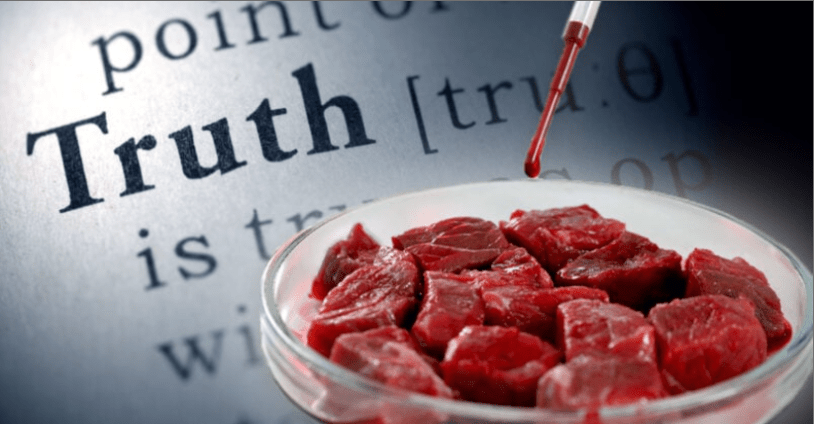
Most cultured meat companies still use fetal bovine serum as the growth medium, which is obtained from unborn calves that are cut out of the womb and drained of their blood while still alive.
By Joseph Mercola/Children’s Health Defense
- While the fake meat industry is being touted as an environmentally friendly and sustainable way to feed the world, the true intent is to recreate the kind of global control that Monsanto and others achieved through patented GMO (genetically modified organism) seed development.
- Researchers at the University of California, Davis (UC Davis) warn there are major environmental downsides to lab-grown meat. According to their “cradle-to-gate life cycle” analysis, the lab-grown meat industry produces up to 25 times more CO2 than traditional animal husbandry, which nullifies the core ideological foundation upon which the industry is built.
- Each kilo of cultured meat produces anywhere from 542 pounds (246 kilos) to 3,325 pounds (1,508 kg) of carbon dioxide emissions, making the climate impact of cultured meat four to 25 times greater than that of conventional beef.
- At present, most cultured meat companies still use fetal bovine serum (FBS) as the growth medium, which is obtained from unborn calves that are cut out of the womb and drained of their blood while still alive. Hence, most claims of cultured meat being animal-free or free of animal cruelty are false.
- Mission Barns is developing imitation bacon made from a mix of cultured meat, cell-cultured pork fat and pea protein. Have the pigs from which the cell samples are taken been treated with mRNA “vaccines,” and if so, is the cultured pork and pork fat safe to eat?
While the fake meat industry is being touted as an environmentally friendly and sustainable way to feed the world, the true intent is to recreate the kind of global control that Monsanto and others achieved through patented GMO seed development.
In the end, lab-created meats are worse for the environment than livestock and will undoubtedly deteriorate human health to boot, just like GMO grains have.
Lab-grown meat is worse for environment than cattle
As reported by the San Francisco Chronicle, researchers at UC Davis warn there are major environmental downsides to lab-grown meat that aren’t part of the conversation or the decision-making process.
According to their “cradle-to-gate life cycle” analysis, the lab-grown meat industry produces up to 25 times more CO2 than traditional animal husbandry, which nullifies the core ideological foundation upon which the industry is built.
As noted by the authors, investors have poured billions of dollars into animal cell-based meat (ACBM) sector based on the theory that cultured meat is more environmentally friendly than beef. But that hype is primarily based on flawed analyses of carbon emissions.
The primary sources of CO2 emissions are the purification processes, which require fossil fuels. The bacteria used to produce the “meat” releases endotoxins, and these must be eliminated from the growth medium or else the cells won’t reproduce properly.
 PERCEPTION RESET