
By Rhoda Wilson/The Expose
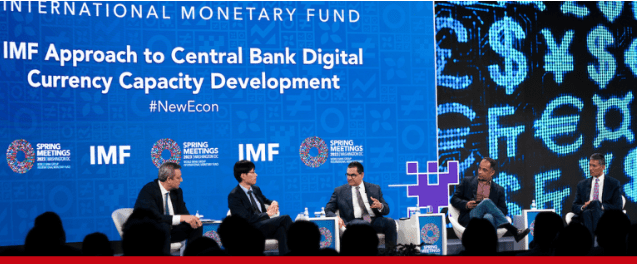
On 10 April, the International Monetary Fund (“IMF”) published the ‘IMF Approach to Central Bank Digital Currency Capacity Development’. It outlines the IMF’s multi-year strategy for aiding central bank digital currency (“CBDC”) rollouts, including the development of a living ‘CBDC Handbook’ for monetary authorities to follow.
As it develops, and includes more details, chapters 8–11 will be of particular interest to us as they relate to the centralised control over our lives using CBDCs that we, the consumers, are most concerned about.
Chapter 8, for example, “will identify design choices, such as operating model, limits in holding, programmability, interest-bearing, and degree of centralization.” And Chapter 11 “will consider the trade-off between data use and privacy protection,” including “what data are generated by CBDC transactions and which institutions might have access to it.”
Programmable Money and Programmability
Programmable money does not appear to have a clear definition.
Last week, IMF Deputy Director Monetary and Capital Markets Department, Dong He, briefly mentioned at a seminar on CBDCs the programmability of CBDCs. “It can be used as a fiscal tool; it can be used for the Internet of Things.” But he doesn’t go into any detail as to what “programmability” means or what effects it has on consumers.
Watch He’s presentation at the ‘Asia Pacific Regional Seminar on Central Bank Digital Currency’ from timestamp 12:54 in the video HERE.
Alexander Lee of the US Federal Reserve wrote in June 2021, the term “programmable money” remains ill-defined. Lee differentiates between “programmable money” and “programmability.” He defines “programmability” as the “mechanism for specifying the automated behaviour of a digital form of money through a computer program.” And he identifies two components of “programmable money”: a digital form of money and programmability. However, Lee warns, “It is not clear whether these components alone are sufficient for a definition, given that various combinations of similar technology for payments automation have existed for decades.”
There have been many claims, for example in a report by the Deutsche Bundesbank, that adding programmability to a CBDC could bring a plethora of economic benefits. However, The FinReg Blog noted, many of the claimed benefits either already exist or could be developed within existing systems.
The SEACEN Centre described programmable money as money with constraints. “It seems to be based on the notion that since money is already digital and exists as records on computers at commercial and/or at central banks, then it is programmable.” You can have programmable central bank money, programmable commercial bank money, programmable e-money (sometimes called stablecoins) and programmable any type of money.
Covid-19 and the ensuing unprecedented economic stimulus seem to have created a mini force towards programmable money. As noted above, programmable money is money with constraints. An analogy is food stamps, where recipients are given coupons, the equivalent of money, which can be spent only on food ‒ not on alcohol, betting on horses, lottery tickets or anything else. In modern guise, these “food stamps” are digitised tokens transacted on a blockchain platform with smart contracts.
 PERCEPTION RESET